
How to Stop Overthinking a Relationship: Break the Anxiety Loop
To stop overthinking a relationship, separate observable facts from feared interpretations, decide what information would actually change your next step, and communicate once instead of repeatedly checking. You do not need to solve every uncertainty. You need a reliable way to respond when uncertainty appears.
If your overthinking isn’t limited to this relationship, see How to Stop Overthinking Everything for the general system.
Recognize the relationship-overthinking loop
A delayed text, different tone, shorter reply, or vague plan creates uncertainty. Your mind generates a threat story, checks for evidence, seeks reassurance, feels brief relief, and then finds a new detail to analyze. The checking feels productive, but it keeps the question open. The loop is maintained less by the first thought than by what you do after it.
Step 1: Name the trigger in one sentence
Write the event without interpretation: ‘They have not replied for six hours.’ Avoid loaded words such as ignoring, withdrawing, or losing interest unless you have direct evidence. Naming the trigger precisely shrinks a cloud of anxiety into one piece of information.
Step 2: Separate facts, stories, and needs
Use three lines. Facts: what happened. Stories: what you fear it means. Needs: the legitimate information, boundary, or reassurance you may require. Example: fact—they cancelled twice; story—I am not important; need—a dependable plan. This prevents a real need from getting buried under twenty imagined explanations.
Step 3: Set an evidence threshold
Decide in advance what would justify action. One slow reply may not. A repeated pattern of cancelled plans might. Ask, ‘What evidence would change my decision?’ If no possible answer would satisfy you, the task is probably tolerating uncertainty—not collecting more clues.
Step 4: Stop digital detective work
Re-reading messages, watching activity indicators, checking follows, and asking friends to decode punctuation rarely creates reliable clarity. Give yourself a checking boundary: one review for practical information, then put the phone in another room for thirty minutes. Replace checking with a task that uses your hands, attention, or body.
Step 5: Communicate the smallest honest question
When clarification is warranted, ask directly and calmly: ‘You have seemed less available this week. Is anything changing for you?’ Do not present a prosecution built from ten clues. One clear question gives the other person room to answer and gives you better data than guessing.
Step 6: Use the one-message rule
Send the message that represents you well, then do not add another message merely to reduce discomfort. Decide when you will revisit the situation—tomorrow morning, after work, or when a response arrives. The waiting period is practice in self-trust, not passive suffering.
Step 7: Judge patterns, not moments
Healthy evaluation uses repeated behavior across time: consistency, honesty, follow-through, repair, and respect. Anxiety tends to use isolated moments. Keep a neutral pattern log for two weeks if you are genuinely unsure. Record plans made, plans kept, direct statements, and repairs. Do not record guesses about tone.
Step 8: Keep your life moving
Overthinking expands when the relationship becomes the only active source of meaning. Keep commitments to work, friends, movement, rest, and creative goals. This is not pretending not to care. It prevents one uncertain interaction from occupying your entire field of attention.
Step 9: Decide what is yours to control
You can communicate, set boundaries, choose availability, and leave situations that repeatedly violate your standards. You cannot force certainty, control another person’s feelings, or prevent all loss. Write one action under ‘mine’ and let the rest remain under ‘not mine.’
A practical 15-minute reset
Set a timer for fifteen minutes. Spend five minutes writing facts and stories, five minutes identifying the next useful action, and five minutes doing it or scheduling it. When the timer ends, return to your day. Rumination without a new decision is not earning more time.
Mistakes to avoid
Do not use reassurance as a bottomless resource. Do not call intuition every anxious prediction. Do not ignore clear patterns in the name of staying calm. Do not send a message you would not stand behind tomorrow. The balance is direct communication plus willingness to tolerate the uncertainty that remains.
Use this today
Choose one exercise from this guide. Make it small enough to complete within twenty-four hours. Write what you will do, when you will do it, and what counts as completion. Confidence grows faster from completed evidence than from another hour of analysis.
Frequently asked questions
Why do I overthink more when I like someone?
The perceived stakes are higher, so ambiguity can feel more threatening. Strong interest does not make every fear accurate.
Should I tell my partner I overthink?
You can explain your pattern without making them responsible for removing every uncomfortable feeling. Ask for specific, reasonable communication rather than unlimited reassurance.
When is overthinking actually a warning?
Look for repeated, observable patterns such as dishonesty, disrespect, unexplained inconsistency, or broken agreements. Respond to the pattern directly.
Related Rewired Mind guides
For the research-informed ideas behind these practical frameworks, see the science behind Rewired Mind.
Stop losing hours to the replay.
This guide covers the pattern. Stop the Loop is the repeatable method — 80 pages written specifically for relationship overthinkers who have already tried ‘just stop thinking about it’ and know it doesn’t work.
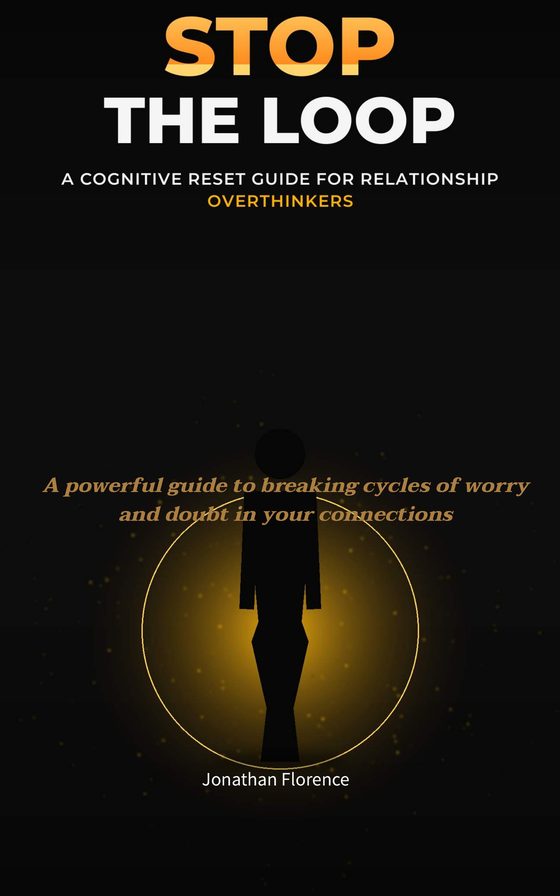
Stop the Loop
A Cognitive Reset Guide for Relationship Overthinkers
$19.99Digital PDF — Instant Download · 80 pages
Get the Digital PDF — $19.99Also: Kindle eBook — Amazon — $6.99 (free with Kindle Unlimited) · Paperback — Amazon — $14.99
Rewired Mind provides educational personal-development information, not medical treatment, psychotherapy, diagnosis, or individualized clinical advice. If distress is persistent, severe, or interferes with daily functioning, consider speaking with a qualified licensed professional.