
Anxious Texting: How to Stop Checking Your Phone
Checking for a reply that hasn't come, rereading a message you already sent, reading meaning into how long someone's taking to respond, watching for a read receipt, rewriting a text three times before it goes out, wanting to send one more message to get some kind of response — these are all versions of the same pattern: reassurance-seeking, playing out on your phone. This guide walks through a 4-step system for catching the urge to check, understanding what's underneath it, and building a way to sit with an unanswered message that doesn't depend on your phone answering it for you.
What anxious texting actually is
The six behaviors this guide is about
Anxious texting isn't one specific action — it's a small cluster of related behaviors that all share the same underlying urge. The most common versions are: checking your phone repeatedly for a reply that hasn't arrived, rereading a message you already sent to look for a mistake or a wrong tone, interpreting a delay in someone's response as meaning something specific about you or the relationship, checking read receipts or online/typing status for information, rewriting a message several times before you're willing to send it, and wanting to send a follow-up text — "hey, did you see this?" — to get any response rather than sitting with the silence. If a few of these sound familiar, this guide is written specifically for that pattern, not for phone use in general.
Why an unanswered message pulls at you the way it does
Part of what makes this hard to shake is that a reply's timing is unpredictable — you genuinely don't know if it's coming in ten seconds or three hours. Uncertain timing can make an outcome harder to stop monitoring because you do not know when new information will arrive. An unanswered message fits that broader pattern: the next check might show nothing, or it might finally show the reply you were waiting for. That's not a claim about how any particular app or phone is built — a reply arriving at an unpredictable time fits that broader pattern the same way a lot of everyday uncertain-outcome situations do. Naming this isn't an excuse for the behavior; it's meant to make clear that the pull you feel isn't a personal flaw — it's a normal response to a genuinely unpredictable situation, and it's interruptible.
Anxious texting is a reassurance-seeking pattern, not a phone problem
How this connects to reassurance-seeking
If you've read our guide on how to stop seeking reassurance, this is that same pattern showing up specifically in your messages. The broader guide covers the general shape of the cycle — asking brings relief in the moment without resolving the uncertainty underneath it, so the urge to ask again comes back the next time doubt shows up. Anxious texting is one everyday way that cycle can show up, because messaging makes checking again available almost instantly. Everything in this guide builds directly on that framework and applies it to the specific behaviors above — checking, rereading, interpreting delays, watching status, rewriting, and re-sending.
Why texting specifically amplifies it
Text strips out tone, pacing, and the small nonverbal cues that usually help you read a message correctly — research on written communication has found that people are often less accurate at judging how their messages come across than they expect, which cuts both ways: it's also harder for you to know what a short reply, a delay, or a single word actually means. That built-in ambiguity is exactly the kind of gap the urge to check tries to fill. For some people, this pattern shows up more intensely in certain relationships than others, and attachment style is one lens some people find useful for thinking about why. That's worth naming as one possible contributing factor — it isn't the only explanation, it isn't a diagnosis, and you don't need a label for it before the steps below will work.
The 4-step system for the moment you want to check again
Step 1: Catch the urge before you check
Notice the moment right before you unlock your phone to check the thread, before you reread what you sent, before you rewrite a draft, or before you're about to send a follow-up. The urge usually has a specific feel — a spike of doubt paired with the sense that checking, rereading, or resending will finally settle it. Catching it in that window is what makes the rest of the steps possible.
Step 2: Name the fear underneath it
Put the actual worry into one plain sentence — not "I need to check if they replied," but the fear driving it: "I'm afraid I upset them," "I'm afraid something happened," "I'm afraid they're losing interest." The checking, rereading, or resending is often an attempt to settle this deeper fear rather than a neutral action. Naming it directly is often more useful than whatever the phone is about to show you.
Step 3: Delay the check, the reread, or the resend on purpose
Set a short, specific delay before you're allowed to act — and be specific about which behavior you're delaying, since they call for slightly different pauses. Delay opening the thread to check for a reply. Delay checking read receipts or online status. Delay rereading a message you already sent. Delay sending a follow-up text. Ten minutes, an hour, or until a natural stopping point in what you're doing all work — the point isn't the exact length; it's creating a gap between the urge and the action so you can decide again before checking.
Step 4: Run the self-check
Before you check, reread, or resend — or once the delay is up — ask three questions instead: What do I actually know? What am I predicting will happen? What action is actually available to me right now? Your answers may show that you already have enough information, that you're predicting an outcome you can't currently confirm, or that the only useful action available is to wait and see.
If it's not just texts
Everything above works the same way for likes, DMs, and app badges, not just texts. The pull of an unread notification is the identical loop: checking brings a small hit of relief without resolving anything, so the urge comes back at the next spike of doubt. Run the same 4 steps — catch the urge, name the fear underneath it, delay the check on purpose, then run the self-check — on any notification, not just a reply thread.
A same-moment reset for checking, rereading, or rewriting
When the urge hits and you need something to do immediately, run this: write down which behavior you're being pulled toward — checking, rereading, checking status, or resending — and your honest answers to the three self-check questions from Step 4. Set a timer for ten minutes and do something else — put the phone face down, start a task, step outside. When the timer ends, check the urge again and decide whether the action still feels necessary.
Common mistakes that keep the checking cycle going
Do not treat every checking urge as proof that something is actually wrong — the intensity of the urge and the accuracy of the worry are two different things. Do not use rewriting a message as a way to check it again without noticing you're doing it. Do not skip Step 2 and go straight to delaying — without naming the fear underneath it, the delay just becomes waiting, not progress. Do not expect the urge to disappear completely; the goal is catching it earlier and more often, not never feeling it again.
Frequently asked questions
Is anxious texting the same as OCD?
Not necessarily. Anxious texting shows up in everyday anxiety and uncertainty for a lot of people, and checking behavior can also be part of obsessive-compulsive disorder (OCD) for some. This guide is written for the everyday version and isn't a diagnostic tool or a substitute for treatment. If the checking is severe, persistent, or interfering with daily life, a licensed professional can help you figure out what's underneath it and the right next step.
Why can't I stop checking my phone for a text back?
A few things are usually working together. An unanswered message is genuinely ambiguous — you can't actually tell from silence alone what a delay means, and research on text-based communication has found that people are often worse at predicting how their own messages will land than they expect, which makes the guessing game run in both directions. On top of that, checking brings a small hit of relief in the moment even when it doesn't get you an actual answer, so the urge to check again comes back the next time doubt shows up. That's the same reassurance-seeking loop covered in our guide on stopping reassurance-seeking — the 4-step system above is built to interrupt it.
Why do I reread messages I've already sent?
Rereading is often an attempt to check your own message for a mistake or the wrong tone after it's too late to change anything. It's the same checking urge as watching for a reply, just aimed backward instead of forward. Step 4's self-check works on it the same way — what do you actually know about how it landed, versus what you're predicting.
Is it always a bad sign if someone leaves you on read?
No. A read receipt tells you only that the message was opened. It does not tell you why a reply has not come yet. Being busy, distracted, thinking about a response, or simply moving on to another task are all possible explanations. Treating a delay as a bad sign is exactly the kind of prediction Step 4's self-check is meant to catch before you act on it.
What if something actually did happen and my check turns out to matter?
That is possible, which is why this guide is not a rule to ignore genuinely time-sensitive information. The goal is to distinguish ordinary repeated checking from situations where you have a concrete reason to act. If you have specific information suggesting something needs immediate attention, respond to the situation rather than using the delay exercise mechanically. Otherwise, the short pause gives you a chance to run the self-check before checking again.
How do I stop compulsively checking notifications?
Use the same 4-step system this guide walks through for texts — catch the urge before you unlock your phone, name the specific fear driving it, delay the check on purpose, then run the self-check. Notification-checking and anxious texting are the same reassurance-seeking loop; texting is just the version most people notice first.
Related Rewired Mind guides
For the research-informed ideas behind these practical frameworks, see the science behind Rewired Mind.
Stop checking. For good.
This guide gives you the 4-step interrupt. Anxious Texting is the whole method — the checking urge, the rereading, the read-receipt spiral, and the follow-up you almost sent — worked through one behaviour at a time, until an unanswered message stops costing you the evening.
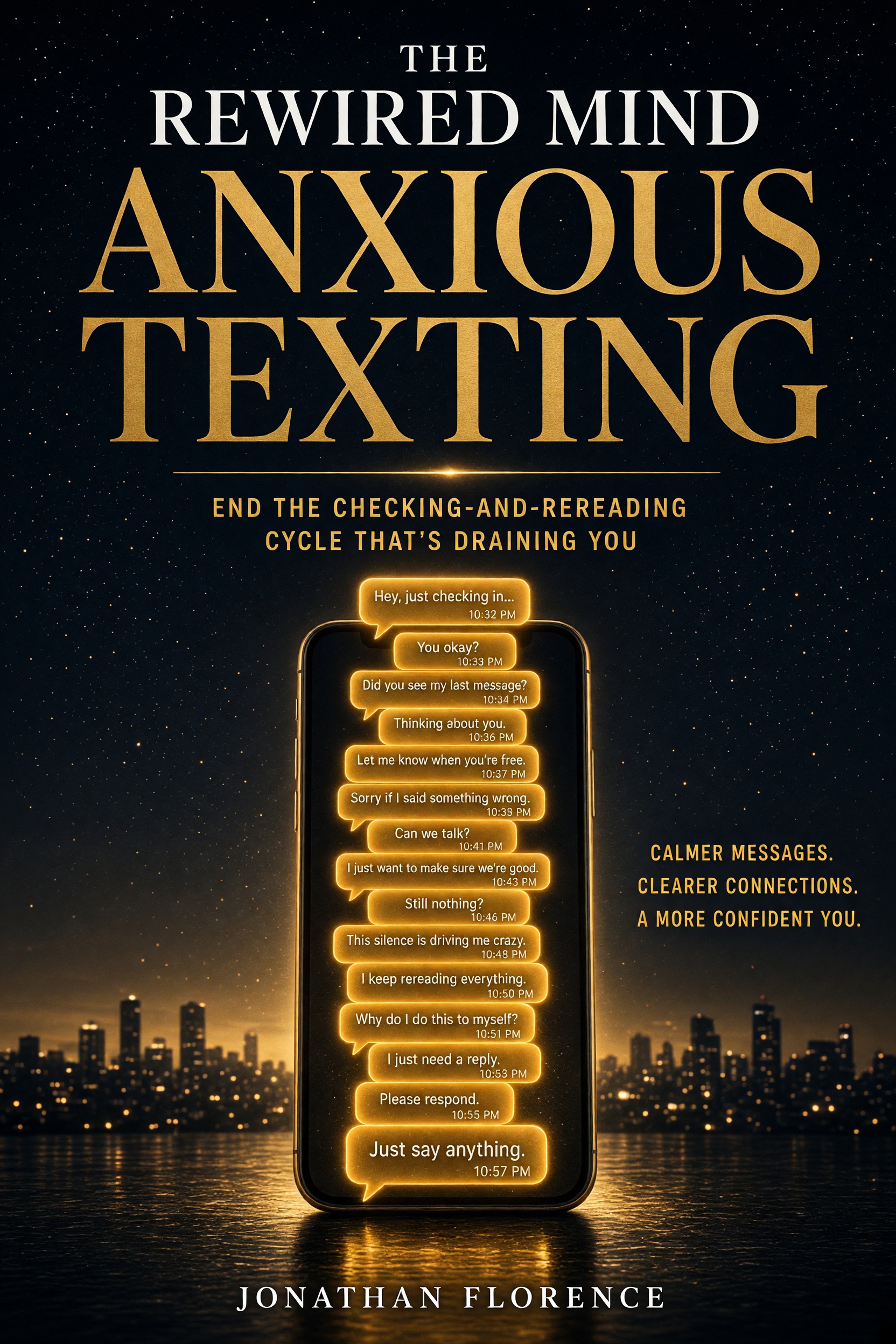
Anxious Texting
End the Checking-and-Rereading Cycle That's Draining You
$17Digital PDF — Instant Download · 54 pages
Get the Digital PDF — $17If the replaying goes wider than texts: Stop the Loop — from $6.99
Rewired Mind provides educational personal-development information, not medical treatment, psychotherapy, diagnosis, or individualized clinical advice. If distress is persistent, severe, or interferes with daily functioning, consider speaking with a qualified licensed professional.