
How to Stop Replaying Conversations in Your Head: A 6-Step System
To stop replaying a conversation in your head, tell the difference between a replay that is teaching you something and one that is just noise, close the ones that have nothing left to give, and give yourself an actual stop point instead of running it on a loop until you fall asleep.
What's actually happening when you replay a conversation
Why your brain won't let it go
Replaying a conversation after it is over is something researchers call post-event processing — the mind re-running a social interaction to check for mistakes, unresolved tension, or things left unsaid. It can feel like preparation for next time, but repeated post-event processing can keep attention locked on the interaction instead of helping you reach a useful conclusion.
The difference between a useful replay and pure noise
Some replays contain something useful. Others simply repeat the same material without producing a new lesson or action. The goal is to identify which kind you are dealing with early. The system below depends on telling these two apart, because a useful replay is worth a few focused minutes, and a noise replay is worth closing immediately.
The 6-step system to stop replaying a conversation
Step 1: Catch the replay early
Notice the moment you cross from remembering a conversation into rehearsing it — the difference is usually the same three or four seconds playing again, word for word, rather than the conversation simply coming to mind. ‘I keep hearing myself say that one line’ is a replay. ‘I remember the conversation’ is not. Catching it in the first minute is much easier than catching it an hour in.
Step 2: Run the signal check
Ask one direct question: is there one specific, learnable thing here, or is this just repetition? A signal looks like: I interrupted them twice and want to watch that next time. Noise looks like: I said ‘you too’ when the waiter said ‘enjoy your meal,’ which has nothing to learn from — only something to stop replaying.
Step 3: If there's a signal, write the one lesson and close it
Write it in one sentence — not the whole conversation, just the lesson. ‘Let them finish before I respond.’ Once it is written, the replay has served its purpose. Running it again after that is not extracting more value; it is just repeating.
Step 4: If there's no signal, label it and let it pass
Say, silently or out loud, ‘this is noise, not a signal.’ Naming it does something a vague attempt to ‘stop thinking about it’ cannot: it gives the replay a reason to be over, instead of just hoping it fades on its own.
Step 5: Set a hard stop right after the conversation ends
If you notice the replay starting soon after a conversation, give yourself an actual limit in that window — two minutes to think it through once, then move to your next action on purpose: open your laptop, start walking, call the next person on your list. The habit of what you do next matters more than trying to will the thought away.
Step 6: Handle nighttime replay differently
Replay can feel more noticeable at night, when there may be fewer tasks or conversations competing for your attention. Keep a ‘parking lot’ — one line on your phone or a notepad by the bed: ‘Look at the thing I said to Sam tomorrow.’ Writing it down and physically closing the notebook or app tells your mind the thought has somewhere to go that is not right now. Deal with it in daylight, when you can actually act on it.
A 5-minute reset for right after an awkward conversation
Set a timer for five minutes as soon as you notice the replay starting. Spend the first minute writing exactly what happened, in one or two sentences, without the story you are telling yourself about it. Spend the next two minutes running the signal check from Step 2 — write the one lesson if there is one, or write ‘noise’ if there is not. Spend the last two minutes doing something physical: stand up, get water, step outside. When the timer ends, go back to whatever you were doing. If the replay returns later the same day, that is normal — repeat the reset rather than treating it as a failure of the first one.
Common mistakes that keep the replay going
Do not journal about it unless the journaling actually reaches a lesson and an endpoint — for some people, writing about a replay just becomes another way of running it, which makes it worse instead of closing it. Do not treat every replay as proof you did something wrong; replaying an interaction is not evidence that the other person judged it the same way you did. Do not reach out to the other person just to relieve your own anxiety in the moment — a message sent to feel better right now is rarely the same message you would send after the five-minute reset. Do not let a genuinely useful lesson get lost inside ten replays of noise — write it down early so you do not need to keep replaying just to remember it.
Frequently asked questions
Why do I replay conversations from years ago?
Old conversations can resurface when something in the present reminds you of a similar situation, feeling, or concern. Sometimes there is no obvious trigger. The important question is whether replaying it now is producing a useful lesson or simply repeating the same material.
Is this a sign of social anxiety?
It can be part of social anxiety, but replaying conversations happens to people without an anxiety diagnosis too. Frequency and distress matter more than the behavior alone — if it's frequent, intense, or interfering with daily life, that's worth discussing with a licensed professional.
Why is it worse at night?
At night there are fewer competing demands on your attention, so a replay that would normally get interrupted by the next task instead has room to run uninterrupted. The nighttime step in this guide is built specifically for that.
Does journaling about it help or make it worse?
It depends on whether the journaling reaches a conclusion. Writing down the one lesson and closing it helps. Writing the same scene over and over in more detail usually doesn't — that's replay wearing a different outfit.
Related Rewired Mind guides
For the research-informed ideas behind these practical frameworks, see the science behind Rewired Mind.
Put the system on a schedule.
Stop Overthinking in 7 Days is the structured version of what you just read — seven days, one focused fix per day, aimed squarely at replaying conversations and second-guessing what you said.
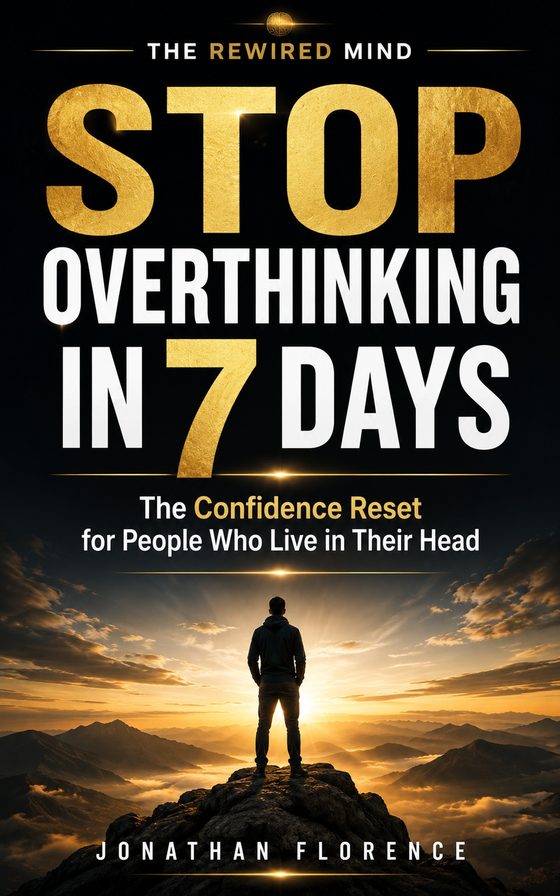
Stop Overthinking in 7 Days
The Confidence Reset for People Who Live in Their Head
$3.99Kindle eBook — Amazon
Get it on Kindle — $3.99Also: Paperback — Amazon — $12.99
Want the full 7-day system as a PDF? The Confidence Reset System — $47
Rewired Mind provides educational personal-development information, not medical treatment, psychotherapy, diagnosis, or individualized clinical advice. If distress is persistent, severe, or interferes with daily functioning, consider speaking with a qualified licensed professional.