
How to Stop Overthinking Everything: A 7-Step System
To stop overthinking everything, interrupt the loop early, sort each thought into a decision or a worry, and give your mind an action to do instead of more analysis. You do not need to resolve every uncertainty before you can move on. You need a repeatable way to close a thought once you have gotten what is useful from it.
If what you keep overthinking is one specific conversation rather than a general pattern, see How to Stop Replaying Conversations in Your Head for a dedicated system.
What overthinking actually is (and why your brain does it)
The difference between overthinking and problem-solving
Problem-solving moves toward a decision or a next step. Overthinking circles the same territory without producing either. You can usually tell which one you are doing by asking: has anything new happened in the last ten minutes of thinking, or am I replaying the same three scenarios? If nothing has changed, the thinking has stopped being useful — even though it still feels active and important.
What causes overthinking
Overthinking is rarely random. It tends to show up around a need for certainty before acting, a fear of being caught off guard again after a past mistake, perfectionism that treats an imperfect decision as a failure, or a habit of giving every thought — big or small — the same amount of attention. None of these causes are flaws in your character. They are patterns, and patterns can be interrupted.
The 7-step system to stop overthinking everything
Step 1: Name what you're actually overthinking
Put it into one plain sentence: ‘I keep replaying the email I sent my manager,’ not ‘I can’t stop thinking about work.’ A vague, sprawling worry is much harder to close than a specific, named one. Naming it also frequently shows you that the actual issue is smaller than the anxious feeling around it. If what you're replaying is a text thread — checking for a reply, rereading what you sent, or wanting to send a follow-up — see anxious texting: how to stop checking your phone for a dedicated system.
Step 2: Ask “is this a decision or a worry?”
A decision has a next action attached to it — send the message, book the appointment, pick a date. A worry is something you cannot act on right now, only tolerate. If it is a decision, move to Step 5 and take the action. If it is a worry, naming that is the win: you stop searching for an action that does not exist yet.
Step 3: Set a time limit on the thought
Give the thought a specific, short window — five or ten minutes, set on an actual timer. ‘I can think about the conversation with my sister until 7:10, then I’m done for tonight.’ A deadline does something a vague intention cannot: it gives your mind permission to stop, because stopping was the plan all along, not a failure of willpower.
Step 4: Write it down to get it out of the loop
Thoughts that stay in your head get replayed because your mind is trying not to lose them. Writing one or two sentences gives the thought a place outside your head, so you do not have to keep mentally rehearsing it just to remember it. You are not trying to write something insightful. You are trying to close a tab.
Step 5: Take one small action tied to the thought
If Step 2 identified a decision, do the smallest real version of it today: draft the message even if you do not send it yet, check the one fact you are actually unsure about, block ten minutes to plan the next step. Action changes the situation from unresolved to in-progress, which can make it easier to stop analyzing the same question repeatedly.
Step 6: Redirect attention on purpose
Once you have named it, timed it, written it down, and acted on what you can, deliberately move your attention to something that uses your hands or body — a walk, a chore, a conversation, a task with a clear start and end. This is not distraction to avoid the thought. It is what closing a loop actually looks like in practice, the same way finishing one task frees you to start the next.
Step 7: Review the pattern, not the moment
Once a week, look back at what you overthought and ask what it had in common: was it mostly decisions, other people’s reactions, or things already in the past? Patterns tell you where to focus your effort. A single moment of overthinking, examined on its own, mostly just tells you that you are human.
A 10-minute reset when you're overthinking right now
Set a timer for ten minutes. Spend the first three minutes writing the thought as one plain sentence, the way you would explain it to a friend in ten seconds — no backstory. Spend the next four minutes sorting it: is this a decision or a worry? If it is a decision, write the smallest possible next action. If it is a worry, write, “There is nothing to do about this right now — I am choosing to set it down.” Spend the final three minutes standing up and doing something physical — refill your water, tidy one surface, step outside. When the timer ends, return to whatever you were doing before the thought started. This will not make the thought disappear forever. It is meant to interrupt the loop long enough for the next hour to be usable.
Common mistakes that keep the loop going
Do not try to think your way out of a feeling. More analysis does not always resolve an uncomfortable feeling; sometimes the more useful move is to allow the feeling to be there while you take the next practical action. Do not treat every worry as equally urgent — some genuinely matter more than others. Do not rely on constant reassurance from other people to feel settled, since relief from reassurance fades fast and pulls you back into checking. Do not skip the action step in Step 5 — writing and naming a thought without ever acting on the decision underneath it just restarts the loop from a different angle.
Frequently asked questions
Why do I overthink everything?
Overthinking usually persists because it feels productive — like you're solving something — even when it isn't producing a decision or new information. It's often reinforced by a need for certainty, past experiences where being caught off guard felt costly, or a habit of treating every thought as equally urgent.
Is overthinking a mental health condition?
Overthinking on its own isn't a diagnosis — it's a thinking pattern that shows up in many contexts, including anxiety. If it's frequent, distressing, or interferes with daily functioning, that's worth discussing with a licensed professional rather than managing alone.
How is overthinking different from anxiety?
Overthinking is a repetitive thinking pattern — replaying or analyzing something past a useful point. Anxiety is a broader stress response that can include physical symptoms and often fuels overthinking, but the two aren't the same thing.
Can you stop overthinking permanently?
The goal isn't to never have a repetitive thought again — it's to catch the pattern earlier and have a reliable way to close it. With practice, the loop gets shorter and easier to interrupt, even if it doesn't disappear completely.
Related Rewired Mind guides
For the research-informed ideas behind these practical frameworks, see the science behind Rewired Mind.
Put the system on a schedule.
Stop Overthinking in 7 Days takes the 7-step system above and gives it a timetable — one focused fix a day, so the loop actually gets shorter instead of just better understood.
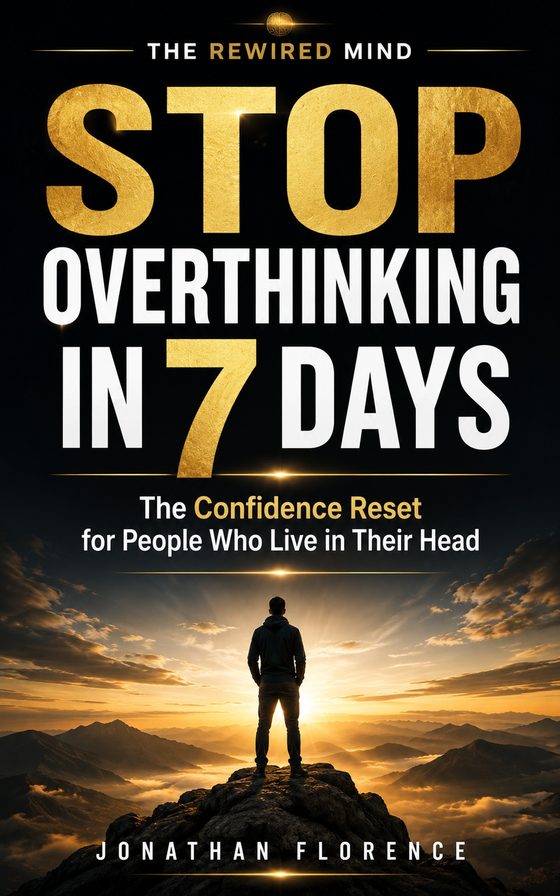
Stop Overthinking in 7 Days
The Confidence Reset for People Who Live in Their Head
$3.99Kindle eBook — Amazon
Get it on Kindle — $3.99Also: Paperback — Amazon — $12.99
Want the full 7-day system as a PDF? The Confidence Reset System — $47
Rewired Mind provides educational personal-development information, not medical treatment, psychotherapy, diagnosis, or individualized clinical advice. If distress is persistent, severe, or interferes with daily functioning, consider speaking with a qualified licensed professional.