
How to Build Self-Trust: A Practical System for Believing Your Own Decisions
You build self-trust by making small promises you can keep, acting according to clear standards, telling yourself the truth, and repairing quickly when you miss. Self-trust is not believing you will always be right. It is knowing you will respond honestly and competently whatever happens.
Self-trust is a relationship with your own word
If you repeatedly promise extreme routines, abandon them, and then insult yourself, your mind learns that your plans are unreliable. The repair is not a bigger promise. It is a smaller agreement followed by consistent evidence. Trust grows through predictability.
Repetitive self-doubt often shows up as general overthinking too — see How to Stop Overthinking Everything for a step-by-step way to interrupt it.
Start with one seven-day promise
Choose a behavior that takes ten minutes or less and connects to a real value: walk after lunch, write one paragraph, review tomorrow’s priorities, or put the phone away at midnight. Define the minimum precisely. For seven days, keep it without adding extra rules. The goal is credibility, not transformation theater.
Distinguish preference, commitment, and experiment
A preference is ‘I would like to.’ A commitment is ‘I will.’ An experiment is ‘I will test this until Friday and review.’ Labeling each correctly prevents casual wishes from becoming evidence against your character. Use commitments sparingly and experiments often.
Write personal decision principles
Create three rules for recurring situations. Examples: ‘I do not make purchases to change my mood,’ ‘I address repeated disrespect directly,’ or ‘I sleep on commitments over a set amount.’ Principles reduce negotiation when emotions are loud and make your future behavior more predictable to yourself.
Tell yourself the complete truth
Self-trust requires accurate self-reporting. Replace ‘I had no time’ with ‘I used the available time for something else.’ Replace ‘They made me say yes’ with ‘I said yes because conflict felt uncomfortable.’ This is not self-punishment. Honest language returns choice and therefore power.
Use a repair protocol
When you miss, do four things: acknowledge it without drama, identify the actual obstacle, reduce or redesign the promise, and complete the smallest repair within twenty-four hours. Shame says the miss reveals who you are. Repair says the system needs information.
Make decisions in writing
For meaningful choices, record the question, criteria, facts, decision, and when it may be reviewed. Written reasoning protects you from mood-based revision. It also shows that trusting yourself means trusting a process, not obeying every impulse.
Practice clean boundaries
Every unnecessary yes can become evidence that your preferences do not matter. Use a pause: ‘Let me check and get back to you.’ Then decide against your priorities. When declining, be respectful and brief. A boundary you keep is a powerful self-trust deposit. The same kind of pause can help with reassurance-seeking too — see how to stop seeking reassurance for a way to delay the ask instead of reaching out right away.
Collect a weekly evidence review
Once a week, answer: What did I say I would do? What did I keep? Where did I repair? What will I change? Include small evidence. The mind often remembers failures more vividly than ordinary follow-through. A written review corrects that bias. For a structured way to generate that evidence in the first place, see confidence exercises that build real evidence.
Example: rebuilding trust after inconsistency
You want to write a book but have abandoned several ambitious schedules. Instead of promising two hours daily, you run a fourteen-day experiment: open the manuscript at 9 a.m. and write for ten minutes Monday through Friday. You track completion, not word count. After fourteen days, you adjust from evidence. The modest plan is not a lack of ambition; it is rebuilding the foundation that larger work requires.
Mistakes to avoid
Do not confuse self-trust with never asking for advice. Do not obey every feeling in the name of authenticity. Do not make promises based on your best-day energy. Do not use one miss to cancel the week. And do not keep commitments that are unsafe, unethical, or based on facts that have materially changed.
Use this today
Choose one exercise from this guide. Make it small enough to complete within twenty-four hours. Write what you will do, when you will do it, and what counts as completion. Confidence grows faster from completed evidence than from another hour of analysis.
Frequently asked questions
How long does it take to build self-trust?
There is no universal deadline. You can create evidence immediately, but reliability becomes convincing through repeated behavior over time.
Can I trust myself if I have made bad decisions?
Yes. Review the process honestly, add safeguards, repair what you can, and make the next decision with better criteria.
Is self-trust the same as confidence?
They overlap. Confidence can be task-specific; self-trust is the broader belief that you will act honestly, decide responsibly, and recover.
Related Rewired Mind guides
For the research-informed ideas behind these practical frameworks, see the science behind Rewired Mind.
Turn self-trust into a repeatable practice.
The Confidence Reset System uses small daily actions to build the kind of evidence self-trust actually rests on — structured across seven days so it compounds instead of fading by Thursday.
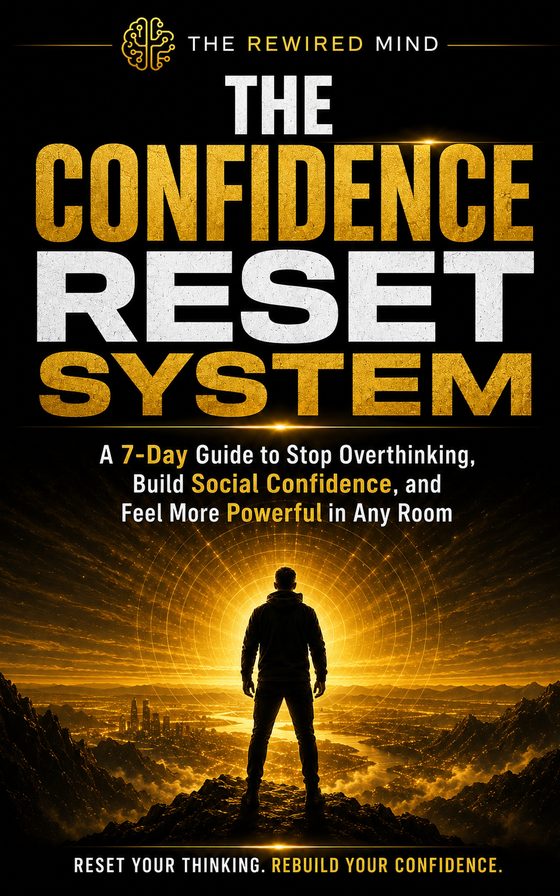
The Confidence Reset System
A 7-Day Guide to Stop Overthinking, Build Social Confidence, and Feel More Powerful in Any Room
$47Complete Digital System — Instant Download
Get the Full System — $47Rather start on Kindle? $6.99 · Paperback $14.99
Rewired Mind provides educational personal-development information, not medical treatment, psychotherapy, diagnosis, or individualized clinical advice. If distress is persistent, severe, or interferes with daily functioning, consider speaking with a qualified licensed professional.