
How to Stop Overthinking After Being Cheated On
If you cannot stop overthinking after being cheated on, you are not weak and you are not going crazy. Betrayal breaks your sense of what was real, so your mind replays the past and scans for the next threat. To quiet it, separate facts from imagined scenes, give your questions a set time instead of answering every spike, stop the checking habit, and rebuild routines that belong to you.
Below is why the loop is so strong after infidelity, seven steps that help, and what to do when the thoughts hit at 2 a.m. This guide is for you whether you are staying, leaving, or still deciding.
Why you can’t stop thinking about it
Being cheated on is not just painful. It changes the story you believed about your relationship, your partner and sometimes yourself. Your mind responds the way it would to any threat it missed: it goes back over everything to find what it overlooked, and it stays on high alert so it is never caught off guard again.
That is why the same questions come back again and again. When did it start? What did they say to each other? How did I not see it? Is it still happening? Each one feels like it needs an answer before you can rest. Most of them do not have an answer that would actually make you feel safe, and that is what keeps the loop running.
Common overthinking loops after infidelity
- Replaying the timeline and looking for the signs you missed.
- Picturing them together, often in more and more detail.
- Comparing yourself to the other person.
- Rereading old messages, photos and social media.
- Checking their phone, location or accounts for new evidence.
- Asking the same questions again, hoping a different answer will settle you.
- Blaming yourself for not seeing it, or for staying, or for leaving.
If you recognise several of these, that is normal. The aim is not to stop thinking about what happened. It is to stop the thinking from running your days and nights.
7 steps to stop overthinking after being cheated on
Step 1: Accept that your brain is doing its job
After betrayal, your mind treats the relationship like a threat it missed. It replays the past to find the warning signs and scans the present so it never gets caught out again. That is why the thoughts feel urgent. Seeing them as a protective reaction, not a sign that you are broken, takes some of the panic out of them.
Step 2: Separate what you know from what you imagine
Draw two columns. In one, write the facts you actually know. In the other, write the scenes, conversations and details you have imagined. Much of the pain comes from the second column, which grows every time you replay it. Facts can be dealt with; imagined scenes only get more vivid with attention.
Step 3: Give the questions a time and a place
If you are trying to work things through with your partner, agree on a set time to talk, for example 30 minutes twice a week, instead of asking whenever a thought spikes. Write questions down as they come so you do not have to hold onto them. This protects both the conversation and your sleep.
Step 4: Stop the checking habit
Checking their phone, location or old messages brings a moment of relief and then a stronger urge to check again. Notice what you are hoping to find, then add friction: log out, delete the app, or agree on openness together. Each time you ride out the urge without checking, it gets weaker.
Step 5: Catch the loop and name it
When the replay starts, label it: “This is the movie again.” Naming a thought puts a little distance between you and it. Then do something physical with a clear end, like a short walk, a shower, or washing up, so your attention has somewhere to go.
Step 6: Rebuild your own routines
Betrayal often makes your whole life revolve around the other person. Bring back things that are yours: sleep times, meals, exercise, friends, work goals. A steadier routine gives your mind fewer empty spaces to fill with replays.
Step 7: Get support, and do not go through it alone
Talk to someone you trust who will listen without pushing you either way. A licensed therapist, especially one experienced with infidelity and trust, can help you work through the hurt and the decision about the relationship. You do not have to work it all out in your head.
When it hits at 2 a.m.
1. Name it. Say or write: “This is the 2 a.m. loop. Nothing new has happened since I went to bed.”
2. Park it. Write the question on a notepad by the bed. It will be there tomorrow, at your set time to talk or think.
3. Slow your breathing. Breathe in for four counts and out for six, ten times. A longer out-breath helps your body calm down.
4. Give your mind something small. Count backwards from 300 in threes, or describe your room in detail in your head. You are not solving anything tonight.
What not to do
Do not make a final decision about the relationship in the middle of a spike. Do not try to get every detail; more detail usually means more vivid replays, not more peace. Do not punish yourself for still thinking about it weeks later. And do not rely only on your partner, or only on yourself, to carry all of this.
If you are staying vs. leaving
If you are staying, the overthinking usually eases as trust is rebuilt through consistent, checkable behaviour over time, not through a perfect answer to every question. Couples counselling with someone experienced in infidelity can give structure to the hard conversations.
If you are leaving or have left, the loop often shifts from “what happened?” to “what is wrong with me?” Notice that shift. Their choice to cheat says more about them than about your worth. Our guide to rebuilding self-esteem can help.
Frequently asked questions
Is it normal to overthink after being cheated on?
Yes. Betrayal breaks your sense of what was true, so your mind keeps going back over the past to rebuild it and scans the present for signs of danger. Replaying, checking and imagining scenes are very common reactions, especially in the first weeks and months.
How long does overthinking last after infidelity?
There is no fixed timeline. For many people the loops are loudest early on and become shorter and less frequent as they get answers, set boundaries and rebuild routines. If they are not easing, or are affecting sleep, work or health, it is worth talking to a licensed therapist.
How do I stop picturing them together?
Do not try to force the image away; that tends to bring it back. Notice it, name it (“that is the movie again”), breathe out slowly, and move your attention to something physical in the room. Over time the image loses its charge.
Should I keep asking my partner questions?
If you are staying together, some questions are part of rebuilding trust. Agree on a set time to talk rather than asking whenever the anxiety spikes. Questions asked in a spike rarely bring lasting relief and often restart the loop.
How do I stop checking their phone or social media?
Write down what you are hoping to find and whether finding it, or not finding it, would actually settle you. Then add friction: log out, remove the app, or agree on transparency together. Checking gives a short burst of relief that keeps the habit going.
Related Rewired Mind guides
Get the free 7-Day Confidence Reset
A short daily plan to quiet the overthinking loop and rebuild confidence, plus one practical idea a week. Free, unsubscribe any time.
No spam. One click to unsubscribe.
Catch the spike before it takes over.
The Jealousy Spiral is a practical method for the moments that drag you back: scrolling their photos at midnight, rereading a text for hidden meaning, asking one more question just to feel okay. Notice, defuse, redirect.
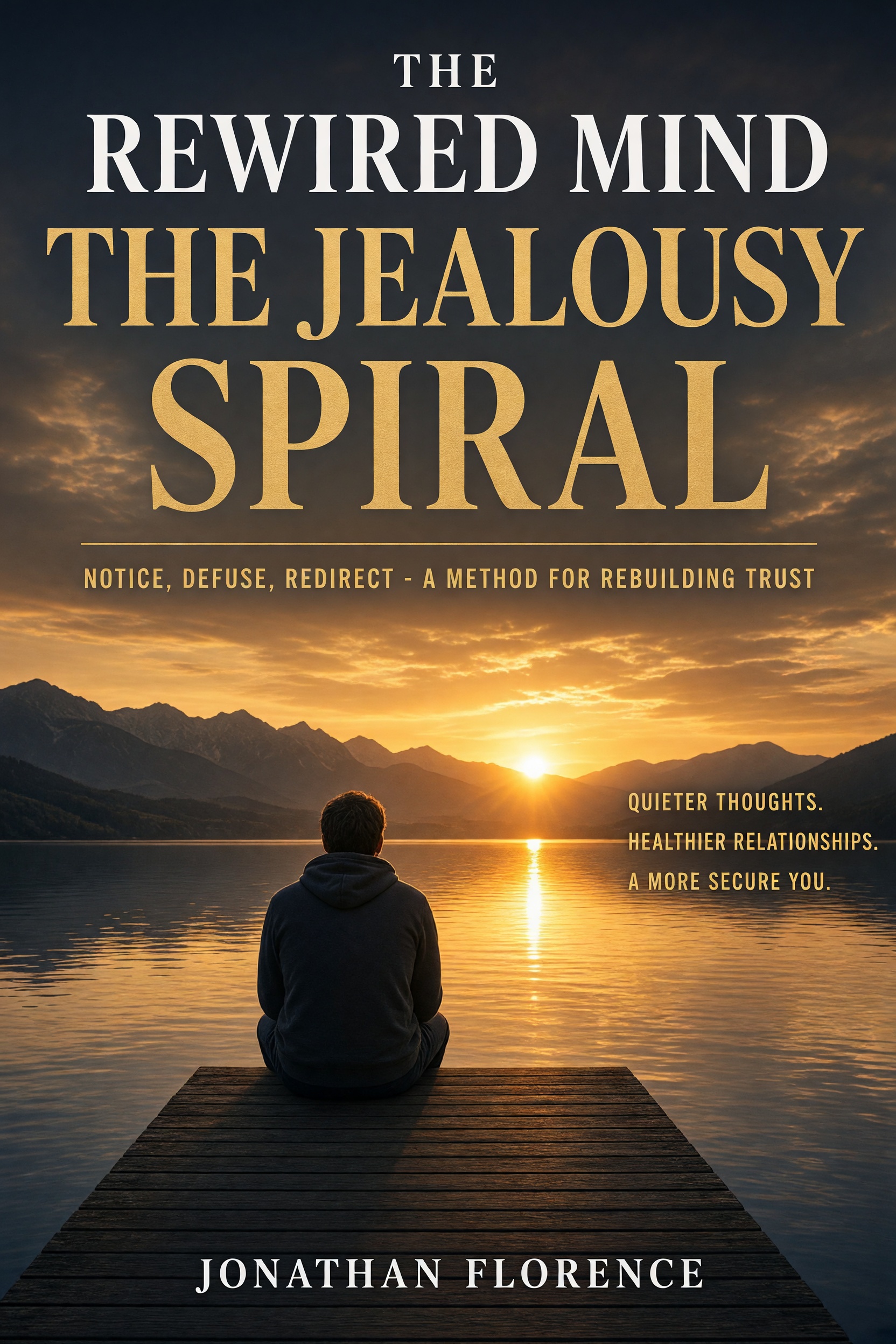
The Jealousy Spiral
Notice, Defuse, Redirect
$17Digital PDF — instant download
Get The Jealousy Spiral — $17Also: Kindle — Amazon — $6.99
Included in The Complete Rewired Mind Library: 12 guides for $47
Rewired Mind provides educational personal-development information, not medical treatment, psychotherapy, diagnosis, or individualized clinical advice. If distress is persistent, severe, or interferes with daily functioning, consider speaking with a qualified licensed professional. If you are ever in danger, or thinking about harming yourself, contact local emergency services or a crisis line right away (in the US, call or text 988).