
How to Be Socially Confident (Even If You Don't Feel Ready)
To be socially confident, you don't wait until you feel ready — you build it the same way you build any skill: through small, repeated participation. Social confidence is the ability to participate while accepting that you may feel nervous, make an awkward moment, or not connect with everyone. Gain it by moving attention outward, practicing small social behaviors repeatedly, and measuring success by participation rather than approval.
Stop waiting to feel socially confident first
Feeling ready is an unreliable entry requirement. Social ease usually follows repeated participation. Begin with behaviors small enough to perform while nervous: greet the cashier, make one comment in a group, ask a follow-up question, or stay ten minutes longer than usual.
Move attention from performance to connection
When you monitor your voice, hands, face, and every word, you have less attention available for the conversation. Pick an outward target: understand one thing about the person, notice the topic, or contribute one useful detail. Rewired Mind’s research page explains why excessive self-focused attention can intensify social anxiety.
Use a three-part conversation structure
You do not need endless clever topics. Observe, ask, relate. Observe something real: ‘This place is busy tonight.’ Ask a question: ‘Have you been here before?’ Relate briefly: ‘It’s my first time; I came for the music.’ Then return the space. This creates a natural rhythm without turning the conversation into an interview.
Build a social-confidence ladder
List ten interactions from easy to difficult. Examples: eye contact and hello; ask a simple question; make small talk for two minutes; attend a group; introduce yourself; share an opinion; invite someone to meet. Practice one level repeatedly before increasing difficulty.
Set process goals for events
Before entering, choose two controllable goals: introduce yourself to two people and ask one genuine follow-up question. Do not make ‘be interesting’ or ‘make everyone like me’ the goal. Process goals give you a finish line and reduce post-event ambiguity.
Allow ordinary pauses
A pause is not proof that you failed. Breathe, look at the other person, and use the last topic: ‘You mentioned you moved recently—how has that been?’ If the conversation ends, let it end politely. Social confidence includes surviving normal endings without treating them as rejection.
Share in small layers
Connection needs some self-disclosure, but not maximum vulnerability at once. Share a preference, then an experience, then something more personal as trust develops. Match the setting and the other person’s level. Gradual disclosure protects boundaries and creates reciprocity.
Recover after awkward moments
Use a simple repair if needed: ‘I said that badly—what I mean is…’ or ‘I lost my train of thought.’ Most moments do not require a repair. After the interaction, record one thing you did well and one specific adjustment. Ban global conclusions such as ‘I am awkward.’ If the moment keeps replaying afterward, see How to Stop Replaying Conversations in Your Head. For a broader set of exercises that build confidence outside social situations too, see confidence exercises that build real evidence.
Practice being the initiator
Waiting to be chosen keeps social outcomes outside your control. Initiate one small contact each week: send the invitation, join the table, ask the question, or introduce two people. Some attempts will not develop. The skill is initiating respectfully and recovering cleanly.
Example: entering a networking event
Your goals are to stay forty minutes, introduce yourself to two people, and ask what brought them there. You arrive, breathe, find someone standing alone, and say, ‘Hi, I’m Jonathan. What brought you to this event?’ You listen for one detail and ask a follow-up. Success is completing the behaviors—not securing a client or feeling relaxed all night.
Mistakes to avoid
Do not use alcohol as your only access to social ease. Do not rehearse complete conversations that real people cannot follow. Do not dominate with questions to avoid sharing. Do not treat every quiet person as disapproving. And do not make one difficult event the verdict on your social ability.
Use this today
Choose one exercise from this guide. Make it small enough to complete within twenty-four hours. Write what you will do, when you will do it, and what counts as completion. Confidence grows faster from completed evidence than from another hour of analysis.
Frequently asked questions
Can introverts have strong social confidence?
Yes. Social confidence is not constant talk or high energy. An introvert can communicate clearly, initiate when needed, and prefer smaller doses of interaction.
What should I do when my mind goes blank?
Slow down, name the pause if necessary, and return to the last concrete detail the person shared. A simple follow-up is enough.
When should I get professional help?
If fear or avoidance significantly interferes with work, relationships, or daily functioning, a licensed mental-health professional can offer individualized assessment and treatment.
How long does it take to build social confidence?
There's no fixed timeline — it tracks how often you practice, not how much time passes. Most people notice a real shift within a few weeks of working through the social-confidence ladder above, because each completed rung is direct evidence, not a feeling you're waiting on.
What's the fastest way to gain social confidence in a new environment?
Set two small process goals before you walk in — introduce yourself to one person, ask one genuine follow-up question — instead of an outcome goal like 'make a good impression.' Process goals give you a finish line you actually control.
Can you become more socially confident if you're naturally shy?
Yes. Shyness is a temperament, not a ceiling. You become more socially confident the same way anyone does — small, repeated participation that gives you direct evidence you can handle the room, rather than waiting to feel like a different person first.
Related Rewired Mind guides
For the research-informed ideas behind these practical frameworks, see the science behind Rewired Mind.
Practice confidence in real rooms.
The Confidence Reset System combines short daily actions, social-confidence drills, and a structured seven-day reset built for the room you actually have to walk into.
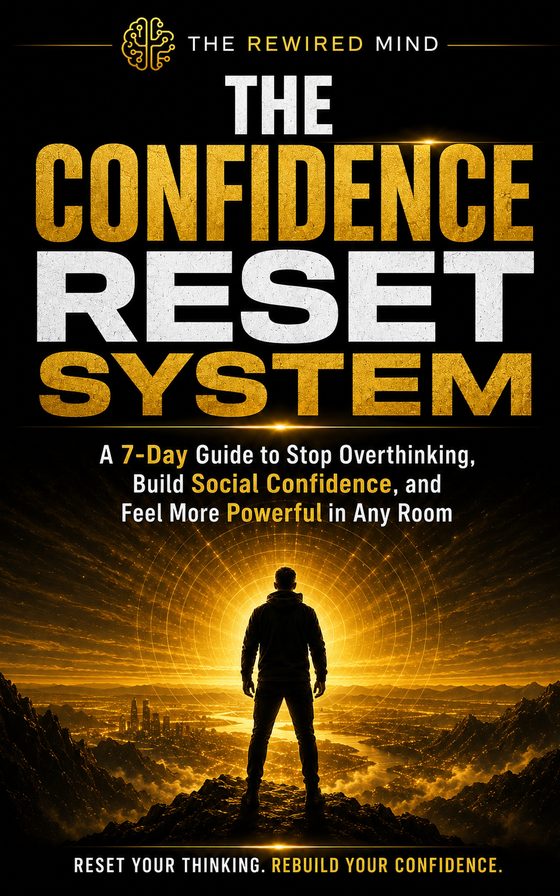
The Confidence Reset System
A 7-Day Guide to Stop Overthinking, Build Social Confidence, and Feel More Powerful in Any Room
$47Complete Digital System — Instant Download
Get the Full System — $47Rather start on Kindle? $6.99 · Paperback $14.99
Rewired Mind provides educational personal-development information, not medical treatment, psychotherapy, diagnosis, or individualized clinical advice. If distress is persistent, severe, or interferes with daily functioning, consider speaking with a qualified licensed professional.