
Confidence Exercises That Build Real Evidence
One practical way to build confidence is to create small pieces of direct evidence about what you're actually capable of, instead of waiting to feel fully ready first. The exercises below are structured like brief experiments: you predict what will happen, you act, you observe what actually happened, and you record it. Over time, the record becomes harder to argue with than the doubt was.
What actually builds confidence (and what doesn't)
Confidence is evidence, not a feeling you wait for
Most confidence advice asks you to change how you feel before you act — feel ready, feel sure, feel calm — and treats action as the reward for getting there. In practice it usually works the other way around. A specific action gives you a different kind of information than a feeling alone can provide: direct experience. You didn't just believe you could handle the conversation, the meeting, or the mistake — you actually did, and now that's part of your history instead of a guess about your history.
Where affirmations and visualization fit in
Affirmations and visualization aren't the enemy here, and for some people they're a genuinely useful part of getting ready to act — rehearsing what you want to say, or reminding yourself of a strength you tend to forget under pressure. What they can't do on their own is produce the kind of evidence that changes what you believe about your own capability. Believing you can do something and having done it are different kinds of proof. Direct experience gives you something concrete to refer back to the next time you're nervous. Use them to prepare if they help you — just don't let preparation stand in for the exercise itself.
The behavioral-experiment framework behind these exercises
How a confidence exercise differs from a confidence tip
A tip tells you what to believe or how to feel. An exercise gives you something specific to do, with a way to check afterward whether your prediction about it was accurate. Anxiety about a situation often includes predictions such as "this will go badly," "people will notice," or "I'll freeze up" — predictions that never get tested, so they never get updated. Each exercise below exists to test one prediction on purpose.
The four-part structure: Predict, Act, Observe, Record
Before each exercise, write down what you expect to happen, in one plain sentence — this is your prediction, and it's what makes the exercise an experiment instead of just an activity. Then act: do the specific thing, once, without over-preparing it into something bigger than it needs to be. Immediately after, observe what actually happened, as close to the facts as you can get, separate from how you felt while it was happening. Finally, record both the prediction and the actual outcome somewhere you'll see again — the comparison between the two is the entire point.
7 confidence exercises that build real evidence
1. Speak up early instead of after everyone else
In your next meeting, discussion, or group conversation, share your opinion, question, or idea within the first few minutes instead of waiting to see what everyone else says first. Predict what you think will happen — something like "people will react badly" or "no one will respond." Do it once. Record what actually happened: what people said, how it landed, and whether it matched the prediction.
2. Initiate instead of waiting to be invited
Pick one thing this week you'd normally wait for someone else to start — starting a conversation with someone you don't know well, proposing the plan instead of waiting for an invitation, or suggesting the next step on a project. Predict what you think will happen if you go first. Do it once. Record what actually happened, including anything that surprised you about how little the moment cost.
3. Practice a skill somewhere you could be seen learning it
Choose a skill you're still building — a language, a sport, a piece of software, a physical movement — and practice it somewhere a person could reasonably see you doing it imperfectly: a class, a shared space, a call with a colleague. Predict how uncomfortable you expect it to feel. Do the practice. Record how the discomfort actually compared to the prediction, and whether anyone reacted the way you feared.
4. Submit something before it feels ready
Choose something you're currently sitting on because it doesn't feel finished — a draft, a message, an idea, a piece of work — and send or share it a day earlier than planned, at whatever stage it's actually at. Predict what you think the reaction will be. Send it. Record the actual response, and specifically whether the gap between "ready" and "good enough" was as large as it felt.
5. Ask the basic question you're editing out
Notice the next time you delete or soften a question because it feels too obvious to ask out loud. Ask it anyway, in plain language, without the disclaimer you'd normally attach to it ("this might be a dumb question, but..."). Predict how you think it will be received. Ask it. Record what actually happened, including whether the reaction matched the one you had predicted. This is different from asking the same question repeatedly for reassurance — if that pattern sounds familiar, see how to stop seeking reassurance.
6. Ask directly for what you actually want
Pick one situation this week where you'd normally accept a default instead of asking for what you actually want — a schedule change, a different item, feedback on something specific, a fair price. Predict the likely response before you ask. Make the direct ask, without over-explaining or apologizing for it. Record what actually happened, including how the other person responded to the direct version compared to what you expected.
7. Choose the slightly harder communication channel
When you have a choice between an easier channel and a slightly harder one — a call instead of a text, an in-person conversation instead of an email, raising something live instead of typing it into a chat — choose the harder one once this week. Predict what you think it will cost you. Have the conversation in that channel. Record what it actually felt like in the moment compared to the prediction, and whether the outcome itself was any different.
A simple evidence log you can reuse for any exercise
Keep it to four lines, in whatever notes app or notebook you already use: what you predicted, what you actually did, what actually happened, and one takeaway in a sentence. The format matters less than the habit of writing it down in the same place every time — after a handful of entries, you have something more persuasive than a single good or bad day: a record.
Common mistakes that keep the exercises from working
Do not pick an exercise where you already know the outcome — if there's no real uncertainty in your prediction, there's nothing for the exercise to prove. Do not skip the record step; evidence that isn't written down gets forgotten or quietly rewritten by whatever the anxious version of the story was. Do not chain several exercises together in one week without reviewing what you've recorded — volume without review produces exhaustion, not evidence. Do not treat one outcome you didn't want as proof the whole approach doesn't work; one exercise is one data point, not a verdict.
Frequently asked questions
How is this different from generic confidence-building tips?
Most confidence advice describes a mindset — think positive, believe in yourself, fake it until you make it. These exercises are structured as small experiments instead: you predict an outcome, take a specific action, and record what actually happened. The confidence comes from the accumulated record of results, not from the advice itself.
Do affirmations or visualization help at all?
They can, for some people, as a way to prepare — rehearsing what you want to say or reminding yourself of a strength you tend to forget under pressure. What they don't do on their own is generate direct evidence about your actual capability. If affirmations or visualization help you prepare, you can pair them with one of the exercises above so the preparation is followed by direct experience.
What if the exercise doesn't go the way I hoped?
That's still useful data. One outcome you didn't want is one data point, not a verdict on your ability. Record what actually happened as accurately as you can, including what you'd do differently, and treat the next exercise as a separate experiment rather than a continuation of the last one.
How often should I do these exercises?
Start with a pace that gives you time to record and review what happened. For many readers, one exercise a week is a simple place to begin. The goal is not to complete as many exercises as possible; it is to notice what your predictions said, what actually happened, and what you want to test next.
Are these confidence-building activities for adults, or do they work for anyone?
They're built as confidence-building activities for adults navigating everyday situations — meetings, relationships, requests, daily decisions — rather than icebreaker-style games designed for classrooms or team events. The underlying framework works at any age, but the examples above assume an adult's day-to-day context.
Related Rewired Mind guides
For the research-informed ideas behind these practical frameworks, see the science behind Rewired Mind.
Turn the exercises into a structured system.
The Confidence Reset System is these exercises on a seven-day schedule — direct, structured practice instead of one-off effort you forget about.
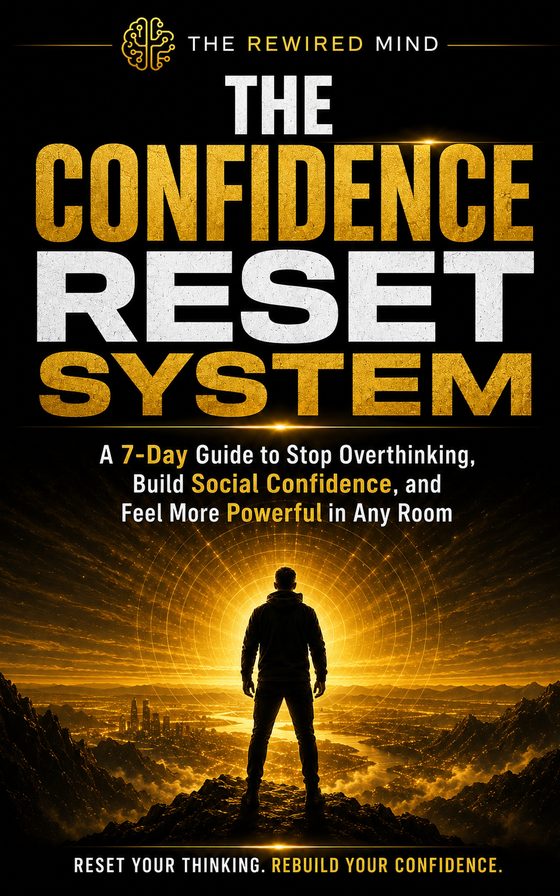
The Confidence Reset System
A 7-Day Guide to Stop Overthinking, Build Social Confidence, and Feel More Powerful in Any Room
$47Complete Digital System — Instant Download
Get the Full System — $47Rather start on Kindle? $6.99 · Paperback $14.99
Rewired Mind provides educational personal-development information, not medical treatment, psychotherapy, diagnosis, or individualized clinical advice. If distress is persistent, severe, or interferes with daily functioning, consider speaking with a qualified licensed professional.