
How to Stop Caring What People Think: 9 Practical Ways to Build Self-Trust
To stop caring so much what people think, stop trying to eliminate every uncomfortable reaction. Decide whose opinions deserve weight, name the standard you want to live by, and take small actions that prove you can tolerate being misunderstood. The goal is not indifference. It is choosing your values over imagined judgment.
Why other people's opinions feel so powerful
Your mind treats social approval as information about safety and belonging. That does not make every opinion accurate or useful. The problem grows when you mind-read—guessing what someone thinks—and then behave as if your guess were a fact. You cancel the post, soften the opinion, avoid the room, or replay a conversation. That relief teaches your brain that judgment was dangerous. A better response is to separate three things: what happened, what you guessed, and what you will do next.
1. Build an opinion filter
Not every opinion earns the same authority. Before changing course, ask: Does this person know me well? Do they understand the goal? Have they built something I respect in this area? Are they trying to help? Feedback from a trusted editor is different from a stranger's reaction. Write three names whose criticism deserves careful consideration. Everyone else can offer data, but not direction.
2. Replace mind-reading with observable facts
After a tense interaction, make two columns. In Facts, write only what a camera could record: ‘She paused before answering.’ In Story, write your interpretation: ‘She thinks I am awkward.’ Facts can guide action. Stories should be tested. A pause might mean distraction, thoughtfulness, or nothing at all. This exercise interrupts the habit of treating uncertainty as rejection.
3. Choose a personal standard before the room chooses one for you
Approval-seeking gets stronger when your own standard is vague. Before a meeting, date, post, or conversation, choose one behavior you control: speak once, ask two genuine questions, state the honest answer kindly, or stay for thirty minutes. Judge the event by that behavior—not by whether everyone approved. This is how self-trust becomes measurable.
4. Practice small doses of harmless disapproval
Confidence grows when you learn that mild disapproval is survivable. Wear the shirt you like. Say ‘I prefer the other option.’ Decline a request without a long defense. Start with a discomfort level of three out of ten, repeat it, then move up. The win is completing the action while discomfort is present—not feeling fearless.
5. Shorten explanations
Overexplaining is often a request for permission disguised as context. Try a complete, respectful sentence: ‘I can’t make it tonight, but thank you for inviting me.’ Do not add five reasons unless the relationship or responsibility genuinely requires them. A clean answer teaches you that your decisions can stand without a courtroom defense.
6. Move attention outward
In social situations, self-monitoring makes every gesture feel important. Give attention a job outside yourself: notice the other person’s last sentence, the task, the room, or the question you want to ask. If you catch yourself checking how you look, return to one external detail. This connects with the research on self-focused attention explained on Rewired Mind’s research page.
7. Use a 24-hour replay limit
If feedback matters, schedule ten minutes to review it. Write what was useful, what was unsupported, and one adjustment. Then close the review. Replaying the same scene without new information is not problem-solving. If the thought returns, say: ‘Reviewed. No new action.’ Redirect to the next concrete task.
8. Keep evidence of self-respect
At the end of each day, record one moment when you acted according to your standard: you spoke honestly, kept a boundary, tried while nervous, or recovered after embarrassment. Evidence is more persuasive than affirmations. After two weeks, you will have a record that your identity can rest on. For a structured way to build that kind of evidence, see confidence exercises that build real evidence.
9. Let people misunderstand you
Sometimes clarification is useful. Sometimes another explanation only feeds the need to control someone’s view. Ask: Is there a practical consequence or important relationship to repair? If not, allow the misunderstanding to exist. Your reputation is shaped by repeated behavior over time, not by winning every interpretation today.
A concrete example
Imagine you share an idea in a meeting and your manager does not react. The old loop says, ‘That sounded stupid,’ and you stay silent next time. The new process is: fact—no visible reaction; story—they disliked it; standard—contribute one useful idea; next action—send the supporting detail or speak again when relevant. You do not need certainty about their opinion to keep acting like the person you want to become.
Mistakes to avoid
Do not turn ‘I do not care’ into hostility. Do not ignore useful feedback because it stings. Do not wait until confidence arrives before practicing. And do not measure progress by never feeling embarrassed. Progress is recovering faster, choosing whose feedback matters, and behaving according to your values more often.
Use this today
Choose one exercise from this guide. Make it small enough to complete within twenty-four hours. Write what you will do, when you will do it, and what counts as completion. Confidence grows faster from completed evidence than from another hour of analysis.
Frequently asked questions
Is it possible to stop caring completely?
Probably not, and complete indifference is not the goal. Healthy relationships require awareness of other people. The useful goal is to care selectively and keep judgment from controlling every decision.
Why do I replay what I said?
Your mind may be trying to resolve uncertainty or prevent future rejection. A short written review with one action works better than unlimited replay. For a deeper, step-by-step system, see How to Stop Replaying Conversations in Your Head.
What if people really are judging me?
They sometimes will. Check whether the judgment contains useful information, make any warranted repair, and keep your life directed by your chosen standards.
Related Rewired Mind guides
For the research-informed ideas behind these practical frameworks, see the science behind Rewired Mind.
Build confidence from evidence, not approval.
The Confidence Reset System is the 7-day rebuild behind this guide — social confidence built from repetition and proof you collected yourself, rather than from other people’s reactions.
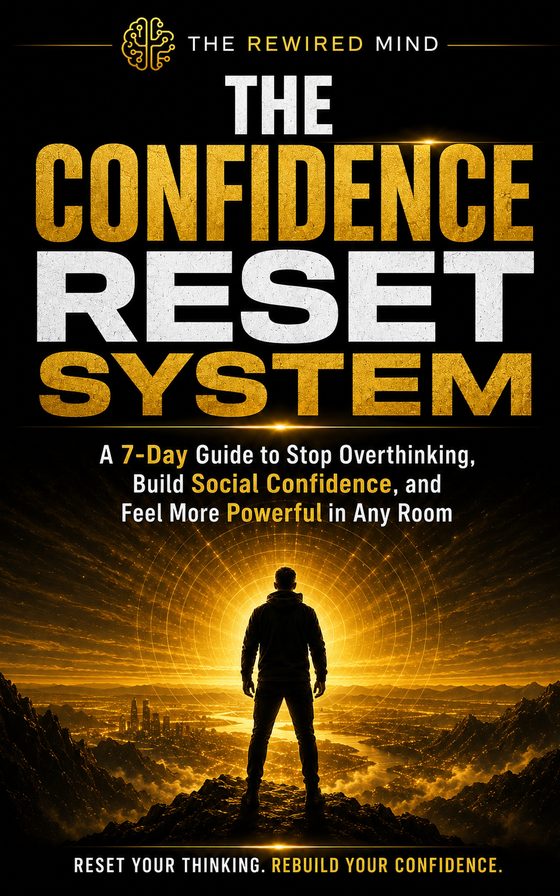
The Confidence Reset System
A 7-Day Guide to Stop Overthinking, Build Social Confidence, and Feel More Powerful in Any Room
$47Complete Digital System — Instant Download
Get the Full System — $47Rather start on Kindle? $6.99 · Paperback $14.99
Rewired Mind provides educational personal-development information, not medical treatment, psychotherapy, diagnosis, or individualized clinical advice. If distress is persistent, severe, or interferes with daily functioning, consider speaking with a qualified licensed professional.