
How to Build Self-Esteem: 8 Practical Steps When Yours Is Low
To build self-esteem, stop waiting to feel worthy before you act. Keep small promises to yourself, answer your inner critic with evidence, and stop handing your sense of worth to other people’s reactions. Self-esteem grows from proof you collect yourself, one small kept commitment at a time.
What is self-esteem?
Self-esteem is your overall opinion of yourself: whether you see yourself as capable, acceptable and worth taking up space. Healthy self-esteem is not thinking you are better than anyone. It is a steady, realistic sense that you are okay as a person, even when you make mistakes.
Low self-esteem is the opposite pattern. You judge yourself more harshly than you would judge anyone else, you discount your wins, and you treat every mistake as proof of what you secretly believe about yourself.
Signs of low self-esteem
- You apologize constantly, even when you did nothing wrong.
- Compliments feel uncomfortable, so you deflect or explain them away.
- You compare yourself with others and almost always come out behind.
- You avoid new challenges because failing would confirm your worst fears.
- You say yes when you mean no, because disapproval feels unbearable.
- You replay mistakes for days while forgetting what went well.
- You need reassurance before you trust your own decisions.
If several of these sound familiar, you are not broken. These are learned habits of thinking and behaving, and habits can be changed.
What keeps self-esteem low
Low self-esteem tends to protect itself. When you believe you are not good enough, you avoid situations that might prove it, so you never collect evidence that you can cope. You filter out wins and spotlight failures. You rely on other people’s approval, which makes your worth feel fragile and outside your control. Each of these keeps the original belief alive. The steps below are designed to break that loop from several directions at once.
How to build self-esteem: 8 practical steps
1. Keep one small promise to yourself every day
Self-esteem is built on self-trust. Each time you say you will do something and then do it, you add proof that your word to yourself means something. Make the promise small enough that you will keep it: a ten-minute walk, one task finished before lunch, going to bed on time. Small and consistent beats big and abandoned.
2. Catch your inner critic and name it
Start noticing the sentences you say to yourself: “I always mess this up,” “Nobody wants to hear from me.” Write them down for a few days. Naming the pattern creates distance. You stop hearing the voice as the truth and start hearing it as a habit.
3. Answer the critic with evidence, not affirmations
Generic affirmations often bounce off when you do not believe them. Instead, ask: what is the evidence for and against this thought? What would I say to a friend who said this about themselves? Then write a fairer, more accurate sentence, such as “I made a mistake in that meeting, and I also handled the rest of it well.”
4. Keep an evidence log
Each evening, write down three things you did, handled or followed through on, however small. Low self-esteem has a memory bias: it forgets wins and remembers failures. The log corrects that bias with facts you can reread on hard days.
5. Stop outsourcing your worth
If your mood rises and falls with other people’s reactions, your self-esteem is on loan. Practice making small decisions without asking for input first, and notice the urge to seek reassurance without acting on it. Our guides on how to stop seeking reassurance and how to stop caring what people think go deeper on this.
6. Set one boundary this week
Every time you agree to something you resent, you send yourself the message that your needs come last. Practice one clear, kind no. It will feel uncomfortable, and that discomfort is part of rebuilding respect for yourself. See how to stop people pleasing for exact scripts.
7. Take small, deliberate risks
Avoidance shrinks your world and confirms the belief that you cannot cope. Choose a challenge one step outside your comfort zone, such as speaking once in a meeting or sending the message you have been putting off, and do it before you feel ready. Courage comes after action, not before it.
8. Treat yourself like someone you are responsible for
Sleep, movement, food and time with supportive people are not rewards for being good enough. They are basic care. When you look after yourself consistently, you are acting as though you matter, and over time your beliefs tend to catch up with your behavior.
A concrete example
Sam rewrites every work email three times and apologizes in most of them. For two weeks, Sam keeps one daily promise (send emails after one review, not three), logs three wins each night, and replaces “sorry to bother you” with a direct first line. Nothing dramatic happens. The emails land fine, nobody reacts to the missing apologies, and by the end of the second week Sam has fourteen days of written proof that the feared outcome did not show up. That proof is what self-esteem is made of.
Mistakes to avoid
- Waiting to feel worthy before acting. The feeling follows the action, not the other way around.
- Trying to fix everything at once. One kept promise beats ten abandoned resolutions.
- Replacing self-criticism with forced positivity. Aim for accurate and fair, not cheerful.
- Measuring progress by mood. Measure it by behavior: what you did despite the doubt.
Use this today
Pick one promise small enough that you cannot fail, write it down, and keep it before the day ends. Tonight, write three things you handled today. Repeat for seven days and reread the list on day eight.
Frequently asked questions
What is low self-esteem?
Low self-esteem is a consistently negative overall opinion of yourself: feeling less capable, less worthy, or less deserving than other people, often regardless of the evidence. It shows up in how you talk to yourself, the risks you avoid, and how much you rely on other people’s approval.
What causes low self-esteem?
There is rarely one cause. Common contributors include harsh criticism earlier in life, repeated comparison with others, setbacks you interpreted as proof you are not good enough, and long periods of avoiding challenges, which leaves you with little evidence of what you can handle.
How long does it take to build self-esteem?
It usually changes gradually. Many people notice they speak to themselves differently and take small risks more easily within a few weeks of consistent practice, while the deeper sense of worth tends to grow over months as evidence accumulates.
Is self-esteem the same as confidence?
They overlap but are not identical. Confidence is usually about your ability in a specific area, like public speaking. Self-esteem is your overall sense of your own worth. You can be confident at work and still have low self-esteem, and building either one tends to support the other.
When should I get professional help for low self-esteem?
If low self-esteem comes with persistent low mood, anxiety that disrupts daily life, or thoughts of harming yourself, speak with a qualified licensed professional. Practical self-help steps can support that work, but they are not a substitute for it.
Related Rewired Mind guides
For the research-informed ideas behind these practical frameworks, see the science behind Rewired Mind.
Build confidence from evidence, not approval.
The Confidence Reset System is a 7-day rebuild — social confidence built from repetition and proof you collected yourself, rather than from other people’s reactions.
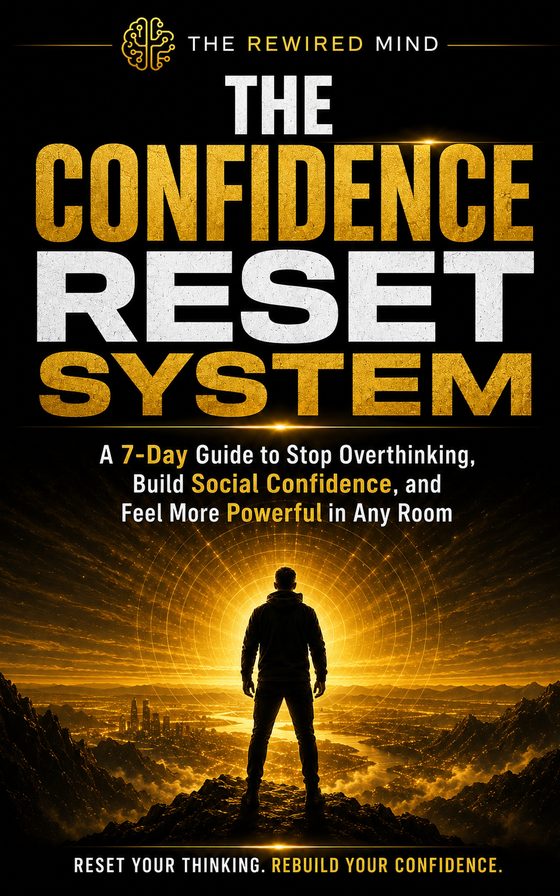
The Confidence Reset System
A 7-Day Guide to Stop Overthinking, Build Social Confidence, and Feel More Powerful in Any Room
$47Complete Digital System — Instant Download
Get the Full System — $47Rather start on Kindle? $6.99 · Paperback $14.99
Rewired Mind provides educational personal-development information, not medical treatment, psychotherapy, diagnosis, or individualized clinical advice. If distress is persistent, severe, or interferes with daily functioning, consider speaking with a qualified licensed professional.