
How to Stop People Pleasing: 9 Practical Steps to Say No Without Guilt
To stop people pleasing, pause before you agree, decide what you actually want, and practice saying no in short, kind sentences without a long defense. The guilt you feel at first is not proof you did something wrong. It is the discomfort of breaking an old habit, and it shrinks each time you survive it.
What is people pleasing?
People pleasing is the habit of putting other people’s approval, comfort, or expectations ahead of your own needs, usually automatically. A people pleaser says yes before thinking, apologizes for things that are not their fault, and feels responsible for keeping everyone happy. Kindness is a choice you make freely. People pleasing is what happens when saying no feels unsafe.
Signs you’re a people pleaser
- You say yes, then immediately wish you had said no.
- You over-explain or apologize when you turn something down.
- You agree with opinions you do not share to avoid friction.
- Someone else’s bad mood feels like your job to fix.
- You struggle to name what you want, even when asked directly.
- You feel resentful or drained, but rarely say why.
- Criticism, even mild, stays with you for days.
If several fit, you are not broken. You have a well-practiced habit, and habits can be retrained.
Why people pleasing happens
People pleasing usually starts as a strategy that once worked: keeping the peace at home, earning approval, or avoiding conflict that felt dangerous. Over time it becomes automatic. Each yes brings quick relief from the fear of disapproval, which teaches your brain to repeat it. The cost shows up later, as exhaustion, resentment, and a sense that your life is organized around other people’s preferences. If the fear underneath is mostly about judgment, How to Stop Caring What People Think goes deeper on that piece.
1. Insert a pause before every yes
The habit lives in the speed of your answer. Give yourself a standard delay: “Let me check and get back to you.” A pause of even an hour lets you decide instead of react. You can always say yes later; taking back a yes is much harder.
2. Ask what you actually want
Before answering, ask yourself three questions: Do I want to do this? Do I have the time and energy? Will I resent it later? If the honest answers are no, no, and yes, you already know your answer. You are allowed to have preferences even when nobody asks for them.
3. Say no in one or two sentences
Long explanations invite negotiation and signal that you think you need permission. Keep it short and kind: “I can’t take that on this week.” “Thanks for thinking of me, but I’ll pass.” “That doesn’t work for me.” You do not owe a detailed defense for a reasonable boundary.
4. Start with low-stakes no’s
Do not begin with your hardest relationship. Practice where the stakes are small: declining an add-on at a store, suggesting a different restaurant, saying you would rather not join a call. Each small no builds evidence that disappointing someone briefly is survivable.
5. Offer a smaller yes when you mean it
Boundaries do not have to be all or nothing. “I can’t help all weekend, but I can come by for two hours on Saturday” is honest and generous. The key is that the smaller yes is something you genuinely choose, not a guilty compromise.
6. Let other people handle their own feelings
Someone may be disappointed when you say no. That is allowed. Their reaction is information about their expectations, not a verdict on whether you were wrong. You can be kind about their disappointment without fixing it by changing your answer.
7. Stop apologizing for having needs
Notice how often you say “sorry” when nothing went wrong. Replace it with “thank you” where it fits: “Thanks for waiting” instead of “Sorry I’m late,” “Thanks for understanding” instead of “Sorry, I can’t.” It is a small change that shifts how you see yourself.
8. Expect guilt and act anyway
The first few boundaries usually bring guilt, replaying, and an urge to take it back. Treat that as a withdrawal symptom, not a warning sign. Give the feeling a time limit: notice it, name it, and do not send the follow-up message that undoes your decision. If you keep replaying the conversation, see How to Stop Replaying Conversations.
9. Keep a record of what happened next
After each no, write down what you feared would happen and what actually happened. Most of the time, the relationship is fine and you got your time back. That record becomes your proof the next time the old fear shows up, and it builds the self-trust people pleasing slowly wears down.
A concrete example
A coworker asks you to cover their shift again, the third time this month. The old pattern is an instant “Sure, no problem,” followed by a ruined weekend. The new pattern: “Let me check and get back to you” (step 1). You realize you don’t want to (step 2). You reply, “I can’t this time, but I hope you find someone” (step 3). You feel guilty for an hour (step 8). On Monday, they found someone else and mention nothing. You write that down (step 9).
Mistakes to avoid
Do not swing to the opposite extreme and say no to everything to prove a point. Do not deliver boundaries with anger you have been saving up; calm and early is easier than late and explosive. Do not wait until you feel confident to start, because confidence comes after the practice, not before it. And do not judge yourself when you slip back into an automatic yes; just use the pause next time.
Use this today
Pick one small request in the next twenty-four hours and use the pause: “Let me check and get back to you.” Then decide what you actually want and answer in two sentences or fewer. Write down what you feared and what happened.
Frequently asked questions
What does people pleasing mean?
People pleasing is a habit of putting other people’s approval, comfort, or expectations ahead of your own needs, often automatically and at your own expense. It is different from kindness, which is a free choice rather than a way to avoid disapproval.
Is people pleasing a bad thing?
Caring about others is good. The problem is the automatic part: agreeing to avoid discomfort, then feeling resentful, drained, or invisible. The goal is to choose when to help, not to stop helping.
How long does it take to stop people pleasing?
It changes through repetition, not insight alone. Most people notice progress after a few weeks of small, deliberate no’s and shorter explanations, while the guilt fades more slowly than the behavior.
Related Rewired Mind guides
For the research-informed ideas behind these practical frameworks, see the science behind Rewired Mind.
Build confidence from evidence, not approval.
The Confidence Reset System is a 7-day rebuild — social confidence built from repetition and proof you collected yourself, rather than from other people’s reactions.
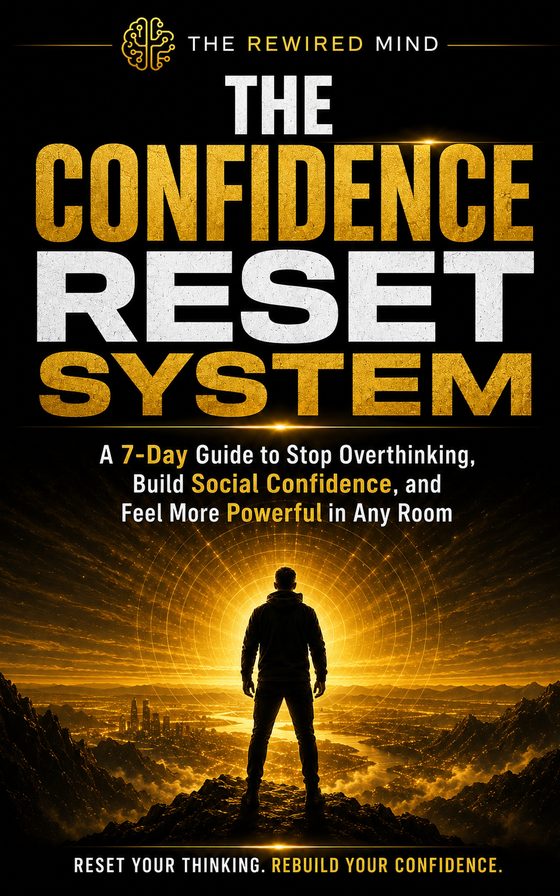
The Confidence Reset System
A 7-Day Guide to Stop Overthinking, Build Social Confidence, and Feel More Powerful in Any Room
$47Complete Digital System — Instant Download
Get the Full System — $47Rather start on Kindle? $6.99 · Paperback $14.99
Rewired Mind provides educational personal-development information, not medical treatment, psychotherapy, diagnosis, or individualized clinical advice. If distress is persistent, severe, or interferes with daily functioning, consider speaking with a qualified licensed professional.