
How to Stop Ruminating: A 7-Step Reset for Repetitive Thought Loops
To stop ruminating, catch the loop early, name it, and ask one question: is there a next action here? If there is, take the smallest version of it. If there isn't, park the thought for a set time and move your attention into something that actually needs it. Rumination loses its grip when it stops getting open-ended airtime.
What rumination actually is
Rumination vs. thinking something through
Rumination is going over the same thoughts, questions, or memories again and again without getting closer to an answer or a decision. It usually sounds like why did this happen, what does it say about me, what if I had done it differently — on repeat. Thinking something through is different: it moves. It ends with a choice, a plan, or a clear "there's nothing to do here."
Psychologists who study rumination often separate a more reflective style (trying to understand a problem so you can act on it) from a more brooding style (dwelling on what's wrong and how bad it feels). The brooding style is the one that tends to keep people stuck, and it's the one this guide is built to interrupt.
The one-question test
When a thought keeps coming back, ask: "Is this moving me toward a next step?" If the honest answer is yes, you're problem-solving — keep going, but put a time limit on it. If the answer is no, and you've had the same thought ten times today, you're ruminating. That difference decides which of the steps below you use.
Why your brain keeps looping
Rumination feels useful. It feels like you're preparing, protecting yourself, or finally about to figure it out — which is exactly why it's hard to stop. A few things make it worse:
- "Why" questions. Abstract questions like "why am I like this?" rarely have a clean answer, so the mind keeps searching.
- Uncertainty. When something is unresolved — a text with no reply, a decision you can't take back — the brain keeps reopening the file.
- Quiet time. Showers, commutes, and lying in bed give a loop room to run without interruption.
- Trying to force it away. Telling yourself "stop thinking about it" usually keeps the thought in the spotlight.
The 7-step reset to stop ruminating
Step 1: Notice the loop
You can't interrupt what you haven't spotted. Common signs you've slipped from thinking into ruminating: the same question keeps coming back word for word, you're replaying a scene you've already replayed, you feel worse after thinking instead of clearer, or you look up and twenty minutes have passed. Catching it in the first minute is far easier than catching it an hour in.
Step 2: Name it
Say it plainly, in your head or out loud: "I'm ruminating about the meeting again." Labeling the process puts a little distance between you and the content. You're no longer inside the thought — you're watching it happen. That small shift is what makes the next step possible.
Step 3: Swap "why" for "what next"
Rumination lives on abstract questions. Turn the question concrete: instead of "why did I say that?", ask "what, if anything, do I want to do about it?" Instead of "why does this always happen to me?", ask "what's one thing I could do differently next time?" Concrete questions have answers. Abstract ones mostly have more questions.
Step 4: If there's an action, shrink it and do it
If Step 3 gives you something real — send the apology, ask the clarifying question, make the appointment, write the email — shrink it to the smallest first move and do it now, or put it on your calendar with a time. A thought that has a scheduled action has much less reason to keep tapping you on the shoulder.
Step 5: If there's no action, park it for later
Some loops have nothing left to give. For those, give yourself a set "thinking window" — 15 minutes at the same time each day, not close to bedtime. When the thought shows up outside that window, write a two- or three-word note and tell yourself: "Not now. 6:30." Many people find that by the time the window arrives, the urge to go over it again has faded. If it hasn't, use the window, and stop when the timer ends.
Step 6: Redirect into something that needs your attention
Redirecting isn't the same as suppressing. You're not fighting the thought — you're giving your attention a better job. Pick something that uses your hands and eyes for ten minutes: a walk where you name five things you see, cooking, tidying one surface, a workout, a conversation, a game that takes focus. Scrolling usually doesn't work, because it leaves plenty of room for the loop to keep running in the background.
Step 7: Close the day on paper
If loops hit hardest at night, do a short brain dump an hour or so before bed. One line per loop: what it's about, and either the next action or "parked — nothing to do tonight." Then close the notebook. The goal isn't to solve everything; it's to give your mind a signal that nothing will be forgotten if you stop holding it.
A 2-minute interrupt for when you're mid-loop
1. Name it: "I'm ruminating about ___." 2. Ask: "Is there one next step?" 3. If yes: write it down with a time. 4. If no: write "parked until ___." 5. Move: stand up and spend the next two minutes doing something physical in the room you're in. Then go back to what you were doing.
When the loop is about a relationship
Relationship rumination has its own flavor: rereading old messages, replaying an argument, checking whether someone has been online, or trying to decode a short reply. The same steps apply, but two extra rules help. First, don't make any big decisions or send any big messages while you're mid-loop — wait until you've done Steps 1 to 3. Second, notice when the loop is really asking for reassurance, because getting reassurance tends to calm the loop for an hour and then feed it again. For more on this, see how to stop overthinking a relationship, anxious texting, and how to stop seeking reassurance.
Common mistakes that keep rumination going
Waiting for certainty before you stop. Some questions won't get a final answer. The goal is to stop feeding the loop, not to win it. Journaling the same scene over and over. Writing helps when it ends in a lesson or an action; rewriting the same story in more detail is just rumination on paper. Talking it through with everyone. One honest conversation can help. Going over it with five different people usually keeps it alive. Expecting it never to come back. Loops return. Each time you catch one faster and step out of it sooner, that's the skill getting stronger.
When to get extra support
Everyone ruminates sometimes. But if repetitive thoughts are taking up hours of your day, keeping you from sleeping, or coming with ongoing low mood, hopelessness, or anxiety that's hard to manage, it's worth talking to a doctor or a licensed mental health professional. If you're ever in crisis or thinking about harming yourself, contact your local emergency number or a crisis line right away — in the US, you can call or text 988.
Frequently asked questions
Is rumination the same as overthinking?
They overlap. Overthinking is the broader term for thinking too much about something. Rumination is a specific kind of overthinking: going over the same thoughts — often about the past, a problem, or what something means about you — without moving toward a solution. For the broader version, see how to stop overthinking everything.
Why do I ruminate more at night?
At night there are fewer things competing for your attention, so a thought that would normally get interrupted by the next task has room to keep running. Tiredness can also make problems feel bigger than they are. Step 7 and a daytime thinking window are built for this.
Can you stop ruminating completely?
Probably not completely, and that's okay. Most people still have loops show up. What practice can change is how quickly you notice them and how long they last. Catching a loop in two minutes instead of two hours is real progress.
Is rumination a sign of anxiety or depression?
Rumination is commonly discussed alongside both, but ruminating doesn't by itself mean you have either. How often it happens, how distressing it is, and whether it's affecting your daily life matter more. If you're concerned, a licensed professional can help you sort that out.
What's the fastest way to stop a rumination loop in the moment?
Name it, ask whether there's one next step, write down either the step or "parked," and then move your body for two minutes. That's the 2-minute interrupt above.
Related Rewired Mind guides
For the research-informed ideas behind these practical frameworks, see the science behind Rewired Mind.
Break the loop for 30 days.
If your loops keep circling back to a relationship — replayed conversations, reread messages, the same questions at night — The Rumination Reset walks you through a 30-day Notice, Defuse, Redirect structure.
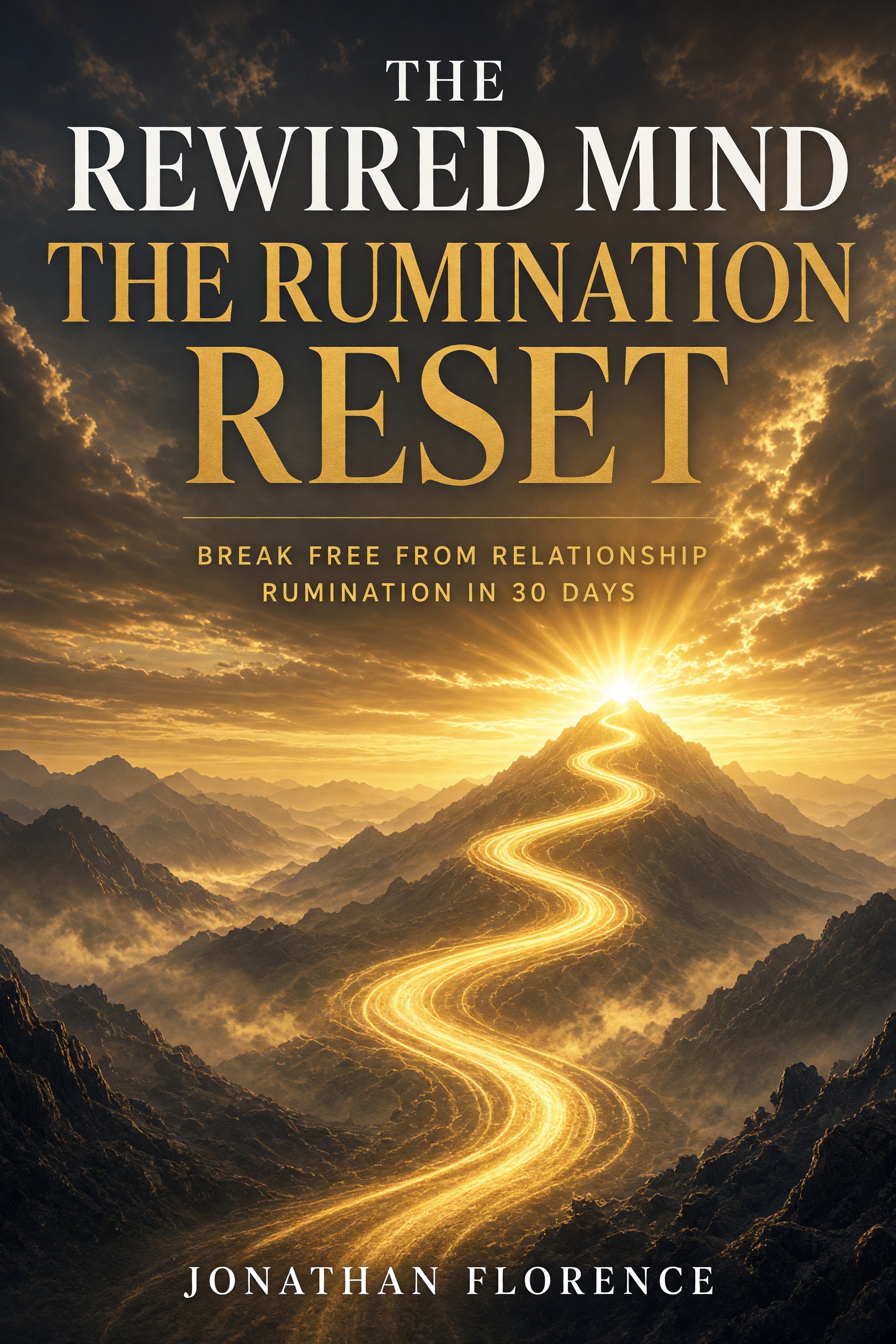
The Rumination Reset
Break Free from Relationship Rumination in 30 Days
$6.99Kindle eBook — Amazon
Get it on Kindle — $6.99Loops not about a relationship? Try Stop Overthinking in 7 Days →
Rewired Mind provides educational personal-development information, not medical treatment, psychotherapy, diagnosis, or individualized clinical advice. If distress is persistent, severe, or interferes with daily functioning, consider speaking with a qualified licensed professional.