
How to Stop Self-Sabotaging: Why You Do It and 7 Steps to Break the Pattern
To stop self-sabotaging, first name the pattern and the moment it shows up, then find what it is protecting you from, and replace it with one small action that moves you forward anyway. Self-sabotage is rarely laziness. It is usually a protective habit, and habits can be retrained.
What is self-sabotage?
Self-sabotage is any behavior that works against what you say you want. You want the promotion but miss the deadline. You want the relationship but pick a fight when it gets close. You want to get fit but skip the workout you planned the night before.
From the outside it looks irrational. From the inside it usually makes sense: the sabotage protects you from something that feels worse in the moment, such as failing after really trying, being judged, or losing something you finally have.
Common self-sabotaging behaviors
- Procrastination on the task that matters most, while staying busy with easy ones.
- Perfectionism that keeps work unfinished so it can never be judged.
- Overcommitting until there is a built-in excuse for falling short.
- Negative self-talk that talks you out of trying before you start.
- Pushing people away when a relationship starts to feel important.
- Quitting early, right before results would have shown up.
- Numbing out with scrolling, snacking or staying up late instead of resting or working.
Why you self-sabotage
Self-sabotage usually protects one of a few beliefs. Fear of failure: if you never fully try, failing does not count. Fear of success: success brings visibility, expectations and the risk of losing it. Low self-worth: if part of you believes you do not deserve good things, you may undo them before someone else can. Comfort with the familiar: even a frustrating situation can feel safer than an unknown one. Our guide on how to build self-esteem covers the worth side of this in depth.
How to stop self-sabotaging: 7 steps
1. Name your specific pattern
“I self-sabotage” is too vague to change. Write down exactly what you do: “I open my laptop to work on the proposal, then clean the kitchen.” A named pattern is easier to catch than a general feeling of failure.
2. Find the trigger moment
Sabotage usually fires at predictable points: right before starting, right before finishing, or right when something starts going well. For one week, note when the urge shows up. Patterns appear fast.
3. Ask what the sabotage is protecting you from
When you catch the urge, ask: “If I did the thing right now, what am I afraid would happen?” The answer is often judgment, disappointment or exposure. Seeing the fear clearly takes away much of its power.
4. Shrink the next step until it feels almost silly
Sabotage thrives on big, vague goals. Replace “write the proposal” with “write the first sentence” or “open the document and set a ten-minute timer.” Small steps slip past the part of you that wants to avoid.
5. Decide in advance, not in the moment
Use if-then plans: “If I feel the urge to scroll when I sit down to work, then I will put my phone in another room and do two minutes first.” Deciding ahead removes the in-the-moment negotiation where sabotage usually wins.
6. Expect discomfort and act anyway
Breaking the pattern will feel uncomfortable at first. That discomfort is not a sign you are doing it wrong. It is the old habit losing its grip. Treat it as a signal you are on the right track rather than a reason to stop.
7. Review without punishment
When you slip, and you will, review it like a coach rather than a critic: what triggered it, what you were avoiding, and what you will try next time. Shame tends to feed the cycle. Curiosity breaks it. If you replay mistakes for days, see how to stop overthinking everything.
A concrete example
Maya wants to launch a small online shop but has been “almost ready” for four months. Tracking her pattern, she notices the urge to tweak her logo shows up every time she is about to set prices. Asking what she is afraid of, the answer is clear: putting a price on her work means someone might say no. She shrinks the step to publishing one product at a price she can defend, sets an if-then plan for the logo urge, and launches that week. The fear did not disappear. She just stopped letting it make the decision.
Mistakes to avoid
- Calling yourself lazy. Labels add shame and hide the real cause.
- Waiting for motivation. Motivation tends to follow action, not lead it.
- Overhauling everything at once. Pick one pattern and work on it for two weeks.
- Treating a slip as proof. One setback is data, not a verdict on who you are.
Use this today
Write one sentence describing your most common self-sabotaging behavior and the moment it shows up. Then write one if-then plan for the next time it appears, and keep it somewhere you will see it.
Frequently asked questions
What does self-sabotaging mean?
Self-sabotaging means acting in ways that undermine your own goals, often without fully realizing it. Procrastinating on the thing that matters most, picking fights in a good relationship, or quitting right before a breakthrough are common examples.
Why do I self-sabotage when things are going well?
Success can feel unfamiliar and risky. If part of you believes you do not deserve it or will lose it anyway, undermining it can feel safer than waiting for it to fall apart. Sabotage gives you a sense of control, even though it costs you the outcome you wanted.
Is self-sabotage the same as procrastination?
Procrastination is one of the most common forms of self-sabotage, but not the only one. Perfectionism, avoidance, overcommitting, negative self-talk and pushing people away can all serve the same protective function.
How long does it take to stop self-sabotaging?
Most people notice the pattern quickly once they start tracking it, but changing it takes repetition. Expect to catch yourself after the fact at first, then in the moment, and eventually before the urge turns into action.
When should I get professional help?
If self-sabotage is tied to persistent low mood, anxiety that disrupts daily life, substance use, or thoughts of harming yourself, speak with a qualified licensed professional. Practical steps can support that work, but they are not a substitute for it.
Related Rewired Mind guides
For the research-informed ideas behind these practical frameworks, see the science behind Rewired Mind.
Build confidence from evidence, not approval.
The Confidence Reset System is a 7-day rebuild — social confidence built from repetition and proof you collected yourself, rather than from other people’s reactions.
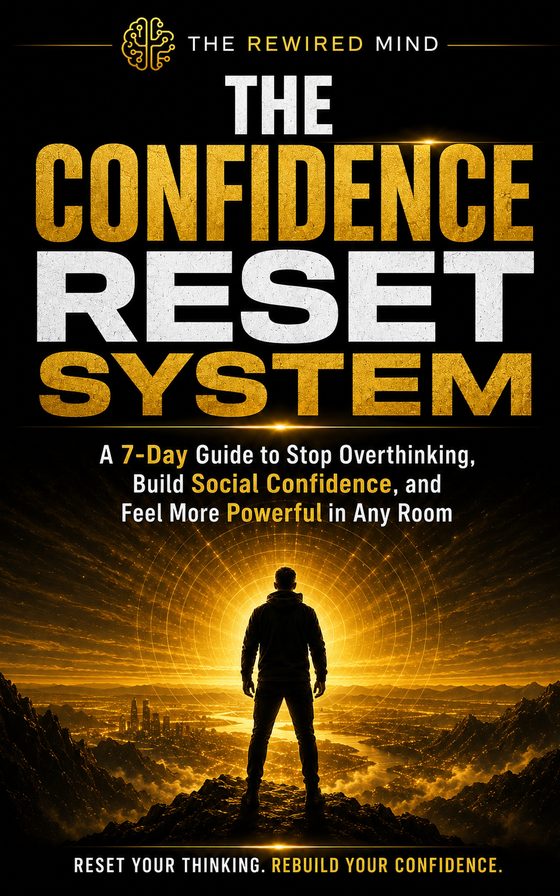
The Confidence Reset System
A 7-Day Guide to Stop Overthinking, Build Social Confidence, and Feel More Powerful in Any Room
$47Complete Digital System — Instant Download
Get the Full System — $47Rather start on Kindle? $6.99 · Paperback $14.99
Rewired Mind provides educational personal-development information, not medical treatment, psychotherapy, diagnosis, or individualized clinical advice. If distress is persistent, severe, or interferes with daily functioning, consider speaking with a qualified licensed professional.