
Overthinking Test: Do You Overthink Everything?
Answer 12 quick questions about how your mind handles decisions, conversations and worries. You'll get an instant overthinking score from 0 to 36, what it says about your thinking pattern, and the one step that will help most at your level.
/ 36
Get my free 10-minute reset planTakes about a minute. You'll get a personalized confidence reset by email.
What your overthinking score means
Your score adds up how often each pattern shows up (Never = 0, Sometimes = 1, Often = 2, Almost always = 3). It measures how much of your attention goes to loops rather than to action. It is not a clinical measure.
0–9: Light overthinker
You think things through, but you usually land on a decision and move on. Overthinking shows up mainly under stress. Your best move is to notice which situations trigger it, so you can catch the loop early when it does start.
10–19: Moderate overthinker
Overthinking is a regular habit in a few areas of your life, often messages, decisions or social situations. You lose time and energy to it, but you can still act. A simple daily routine for interrupting the loop will make a noticeable difference within a week or two.
20–28: High overthinker
Loops are your default response to uncertainty. You probably delay decisions, seek reassurance and replay conversations often enough that it affects sleep, confidence or relationships. You need a structured system, not more insight, because understanding the loop hasn't been enough to stop it.
29–36: Intense overthinker
Overthinking is running most of your day. Use the steps below, and if it's also causing persistent distress, trouble sleeping or difficulty functioning, talk to a licensed professional. That's a sign of how much you're carrying, not a sign of weakness.
3 ways to interrupt an overthinking loop today
- Name it in four words. When you catch yourself replaying something, say "I'm looping on this." Labeling the pattern puts a gap between you and the thought.
- Sort the thought: decision or worry? If it's a decision, set a deadline and pick the best option you have by then. If it's a worry you can't act on yet, write it down and schedule ten minutes for it later.
- Give your mind a next action. Overthinking fills empty space. Choose one small physical step (send the message, write the first line, take a walk) and do it within two minutes.
For the full method, read How to Stop Overthinking Everything: A 7-Step System. If your highest answers were about texts and partners, start with How to Stop Overthinking a Relationship.
Common questions
Is this overthinking test accurate?
It's a self-reflection tool built around common overthinking patterns: rumination, decision delay, reassurance seeking and reading into messages. It's useful for spotting which patterns show up most for you, but it isn't a psychological assessment or diagnosis.
What counts as overthinking?
Overthinking means analyzing, replaying or worrying about something past the point where it helps. Thinking becomes overthinking when it stops leading to a decision or action and starts costing you sleep, time or confidence.
Can you stop overthinking?
Most people don't stop having overthinking thoughts entirely, but they can make the loops much shorter. Catching the loop early, separating decisions from worries and taking small actions quickly are skills you can practice.
Should I retake the test?
Yes. Retake it in two to four weeks after practicing the steps above. A lower score is a simple way to see whether your new habits are working.
Put the system on a schedule.
Stop Overthinking in 7 Days takes the 7-step system above and gives it a timetable — one focused fix a day, so the loop actually gets shorter instead of just better understood.
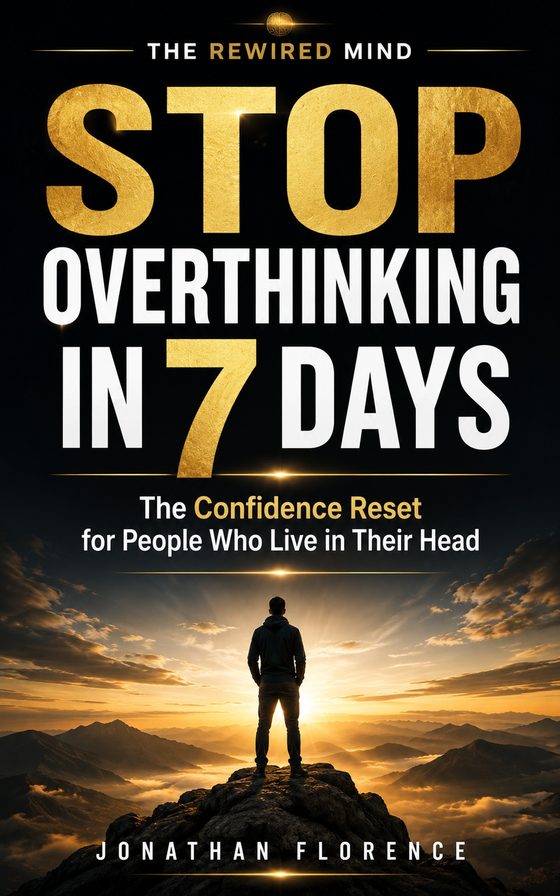
Stop Overthinking in 7 Days
The Confidence Reset for People Who Live in Their Head
$3.99Kindle eBook — Amazon
Get it on Kindle — $3.99Also: Paperback — Amazon — $12.99
Want the full 7-day system as a PDF? The Confidence Reset System — $47
Rewired Mind provides educational personal-development information, not medical treatment, psychotherapy, diagnosis, or individualized clinical advice. If distress is persistent, severe, or interferes with daily functioning, consider speaking with a qualified licensed professional.